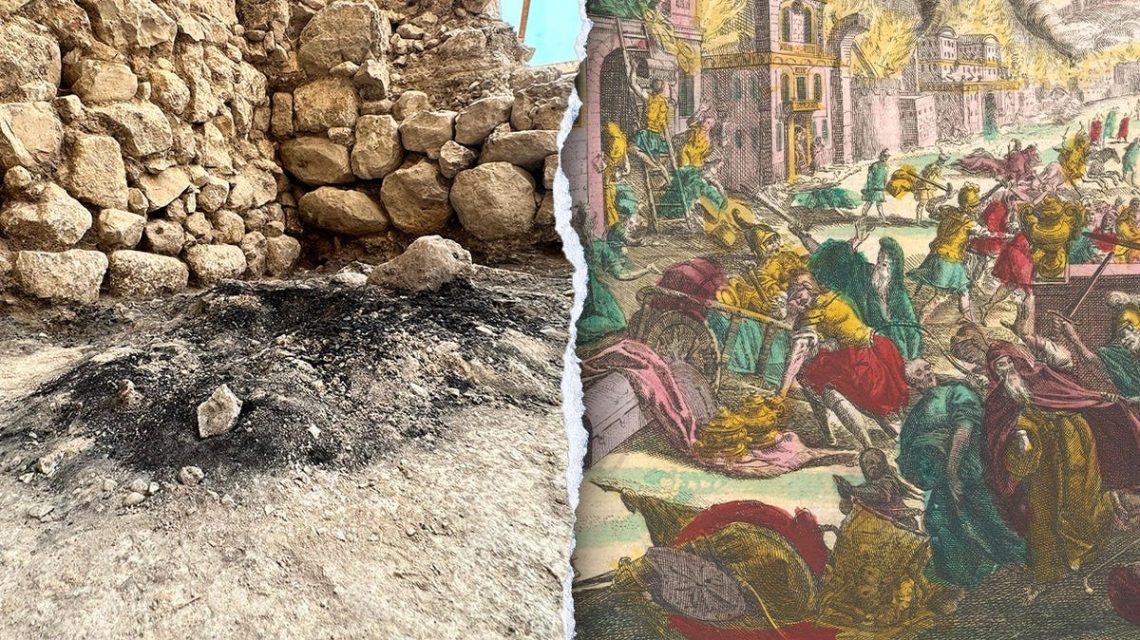
Archaeologists have uncovered charred wooden beams in Jerusalem, remnants from approximately 2,600 years ago, potentially from the destruction of Solomon’s Temple. The Israel Antiquities Authority (IAA) announced the discovery, found beneath a parking lot in the City of David, in July.
According to IAA officials, these beams were located within a building that collapsed during the First Temple’s destruction. The intense fire at the time likely caused the collapse.
What likely preserved the beams for approximately 2,600 years was plaster that melted from the building’s walls, sealing the burnt wood beneath it.
Solomon’s Temple, known as the First Temple, was destroyed by Babylonian King Nebuchadnezzar II in 586 B.C. His forces captured Jerusalem after a prolonged siege. King Solomon originally constructed the temple in the 10th century B.C., housing the Ark of the Covenant.
The destruction marked the start of the Second Temple period, during which Jesus lived.
Efrat Bocher, an excavation director, indicated the beams likely served as the roof of an inner courtyard before collapsing during the destruction. Bocher noted,
We believe that the plaster cladding of the building’s walls, melted by the fire, covered the charred wooden beams, and ultimately enabled their exceptional preservation.
The beams possess a substantial number of growth rings, potentially narrowing the dating within a decade. Johanna Regev, a radiocarbon dating specialist at IAA, stated,
It is very rare in Israel to find wood with such a large number of growth rings.
Regev emphasized the beams’ research potential:
Here, in the City of David, we found thick beams with many rings, offering significant research potential — with more growth rings enabling higher dating resolution.
This discovery provides a vivid glimpse into the past. Regev commented,
This discovery makes you feel that you are witnessing the very moment of destruction, the moment when it all happened.
Regev explained that dating accuracy now increases significantly, narrowing estimates to within about ten years. Interestingly, some experts believe residents of Jerusalem deliberately left the ruins to remember the past.
Excavation director Yiftah Shalev observed,
Preserving memory is a human need, seeking to preserve what once existed.
He continued,
Here we see it in its clearest form: a deliberate choice to leave ruins in place as a testament to the destruction and build the new layer over them.
This discovery is deeply moving, offering a rare look at a pivotal historical moment and providing valuable insights into the past. Jerusalem remains a treasure trove of archaeological finds, with numerous significant discoveries ongoing in the city.
 Fire Amoeba Discovery Challenges Limits of Complex Organisms
  Impact of Sleep Types on Disease Risk
  Ice Age Mastodon Tooth Unearthed in California Creek
  The Unique Challenges of the Pumpkin Toadlet
  Animal Self-Medication Insights
  Carlo Rovelli’s Perspective on Physics and Ultimate Reality