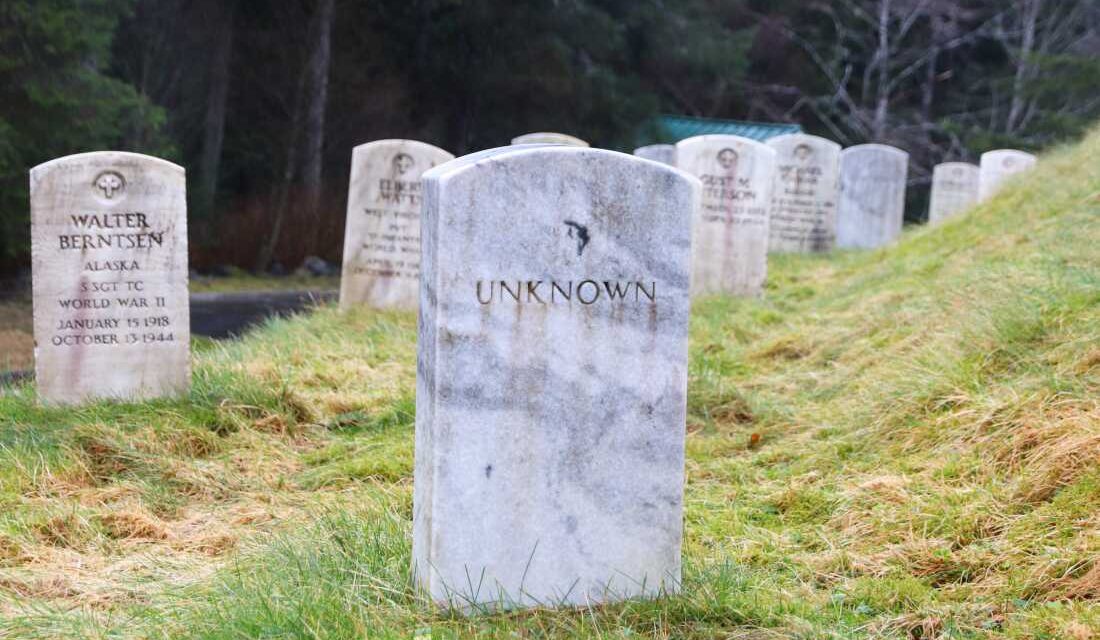
Remembering ‘X-3’ at Sitka National Cemetery
An unidentified soldier, referred to as ‘X-3,’ lies buried at Sitka National Cemetery in Alaska. His headstone reads ‘Unknown.’ In June, a solemn group of service members, veterans, and local authorities gathered in Sitka. Two U.S. Coast Guardsmen carried a flag-draped case to a hearse, signifying the disinterment and transportation of X-3’s remains. This ceremony didn’t honor the newly deceased; it marked the beginning of attempts to identify X-3, a soldier missing for over 80 years.
Finding Lost Heroes
More than 81,000 U.S. service members remain unidentified or missing. Most are casualties from World War II, the Vietnam War, and the Korean War. The Department of Defense (DOD) is charged with locating and identifying them. Battles rarely occurred on U.S. soil, making these remains scarce here. But military action during WWII in Alaska and Hawaii yields more unknown soldiers. Currently, DOD reports approximately 120 in Alaska and 1,900 in Hawaii.
The remains of the unidentified soldier known as ‘X-3’ were loaded into a hearse before being sent to a Midwest forensics lab.
The Aleutians Plane Crash
The tale of X-3 begins June 3, 1942, when Japan attacked Unalaska, roughly 800 air miles from Anchorage, in the Aleutian Islands. The U.S. responded by deploying military resources to fend off the assault. Michael Livingston, a local history enthusiast, recounts a plane crash in Cold Bay, Alaska Peninsula, where all 16 servicemen onboard perished. Ten soldiers remain missing, while six bodies were found by a fur trapper and initially buried locally. Later, the military reburied them, moving most to their hometowns, leaving X-3 as the sole unidentified.
Could X-3 Be Christensen?
Texas resident Chris Pfeiffer, 71, sought answers about his grandmother’s brother lost in the Aleutian crash. He suspects X-3 might be his great uncle, 2nd Lt. Eugene Christensen from Nebraska. Enlisting at 21, Christensen joined the Army Air Forces and died after less than a year of service. Pfeiffer collected extensive records and petitioned DOD for identification efforts, sharing hope and realism about the outcome. His family never knew Christensen’s fate, underscoring the urgency for disinterment progress.
A photo of 2nd Lt. Eugene Christensen of Nebraska. Courtesy of Chris Pfeiffer.
The Quest for Identification
Aaron Cummings from the Defense POW/MIA Accounting Agency (DPAA) leads efforts to retrieve and identify missing servicemen. Since 2017, DPAA engaged with X-3’s case, but Pfeiffer’s involvement expedited progress. Dorfness and mission prioritization hinder resolution. Family interest influences the agency’s focus. In late June, a DPAA team investigated Sitka’s national cemetery, facing challenges when an unrelated excavation yielded nothing. Fortuitously, X-3’s remains lay mere feet below. The extraction was esteemed and respectful, noted Cummings.
The Path Forward
With X-3 disinterred, the next step involves historical data synthesis with modern tools like dental and DNA analysis. Ultimately, these efforts determine X-3’s identity before his final internment. Should X-3 be Christensen, Pfeiffer plans the soldier’s reburial in Nebraska’s Lutheran cemetery with family. Regardless of identity, resolving cases like X-3 exemplifies national commitment to repatriate heroes, validating the nation’s pledge to leave no one behind.
 Teen Arrested in Penn State Student’s Murder; Second Suspect at Large
  Carnival Panorama Passenger Jumped Overboard During Final Leg of Cruise
  Nikole Hannah-Jones Reflects on Educational Choices for Her Daughter
  Life and Challenges at Chennai’s Kasimedu Fishing Harbour
  Chicago Bears Eye Potential Move to Indiana: A Look at the Developments
  Amazon Offers Discounts to Employees at Whole Foods