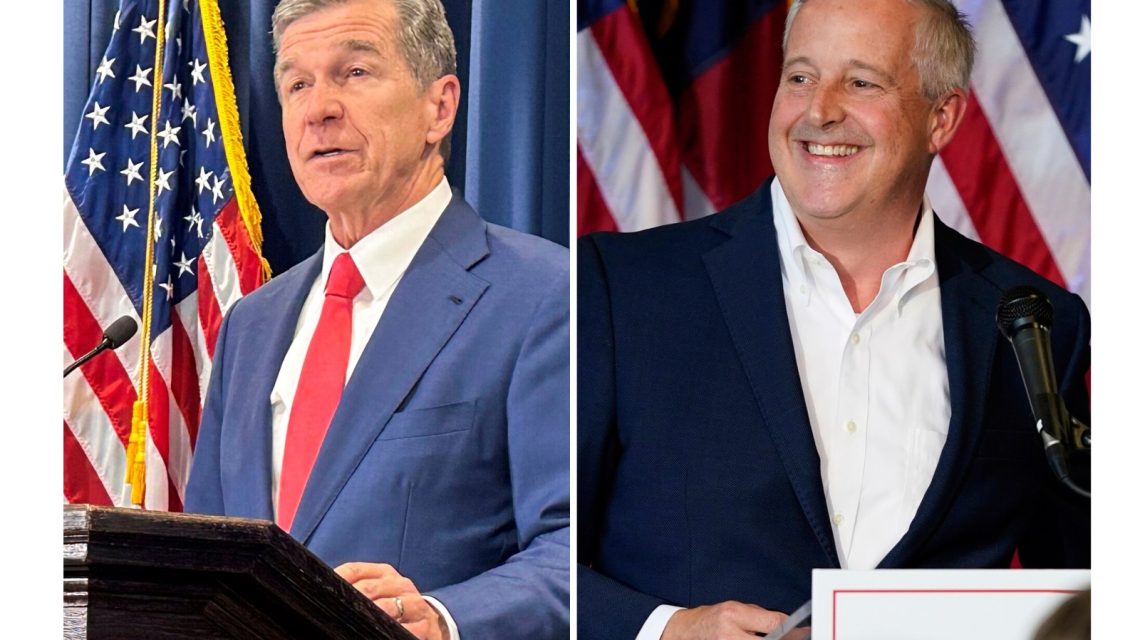
A recent poll conducted by Fox News has unveiled new challenges for Republicans in the North Carolina Senate race, showing former Democratic Governor Roy Cooper with a significant lead over Republican candidate Michael Whatley. Cooper is currently ahead by 9 percentage points, securing 53% compared to Whatley’s 44%. This outcome suggests increasing optimism among Democrats about capturing a pivotal Senate seat.
The survey revealed concerning statistics for Republicans, highlighting a significant enthusiasm gap. Fifty-one percent of Democratic voters expressed being ‘extremely interested’ in the upcoming midterm elections, compared to 42% of Republicans. Furthermore, 58% of Democrats stated they are extremely motivated to vote, contrasted with 50% of Republicans. These indicators of Democratic fervor could play a decisive role in the elections.
Newsweek reached out to both campaigns for comment.
The enthusiasm gap appears to reinforce Cooper’s lead. Among voters who declare they are ‘extremely interested,’ Cooper garners 57% against Whatley’s 42%, a 15-point lead. He also holds a 13-point advantage among those ‘extremely motivated’ to vote, with a tally of 55% to 42%. Voters who declare themselves ‘certain’ to vote show Cooper maintaining a 9-point lead (53% versus 44%). Such data points are particularly significant as they pertain to highly engaged voters who are more likely to vote on Election Day.
Republican pollster Daron Shaw commented on these findings, indicating that Republicans typically enjoy a 3-point advantage in statewide races; however, Cooper’s advantage is rooted in strong Democratic support and favorable responses from independents.
Among independents, Cooper commands a 60% to 34% lead over Whatley. The poll highlighted Whatley’s favorability at 40% along with a 46% unfavorable rating, while Cooper’s favorability stood at 54%, with an unfavorable rating of 44%.
Why the North Carolina Race Is Critical
The North Carolina contest holds substantial weight for the future control of the U.S. Senate. Republicans currently hold a 53-45 majority, not counting Independents Bernie Sanders and Angus King who caucus with Democrats. Democrats view flipping this seat as a vital part of regaining Senate control. For Republicans, maintaining this seat is crucial for their majority.
The race presents an important opportunity given Republican Thom Tillis’s decision not to seek re-election. Historically, federal races in North Carolina have posed challenges for Democrats, who last claimed victory in presidential or Senate races in 2008. Former President Trump edged out then-Vice President Kamala Harris by over 3 points in the state during the 2024 presidential election.
Additional polling consistently shows Cooper with an advantage, reflecting his favorable statewide reputation. Election analysts have tilted the contest in favor of Democrats. With North Carolina expected to be a key Senate battleground in the 2026 midterms, closing the enthusiasm gap and solidifying their base will be essential as Republicans aim to counter Cooper’s lead.
Insights from Other Polls
A Public Policy Polling survey indicates Cooper stands at 48% against Whatley’s 44%, polling 759 voters on July 10 and 11, with a margin of error of 3.6%. Furthermore, a New York Times/Siena University poll reflects a 7-point lead for Cooper, at 50% compared to Whatley’s 43%, surveying 601 likely voters from June 15 to June 27, with a margin of error of 4.7%. The Cook Political Report has classified the race as ‘lean Democrat.’
 Mayor Mamdani and President Trump Discuss Major Housing Project in NYC
  Poll Reveals MAGA’s Increasing Popularity Over DSA as Democrats’ Future Debated
  North Korea’s Hypersonic Weapon Test Amid Global Tensions
  Debate Over ICE Action in Austin Escalates
  President Trump Warns of Escalating War with Iran at UN Assembly
  Tariffs and Their Impact on Everyday Products