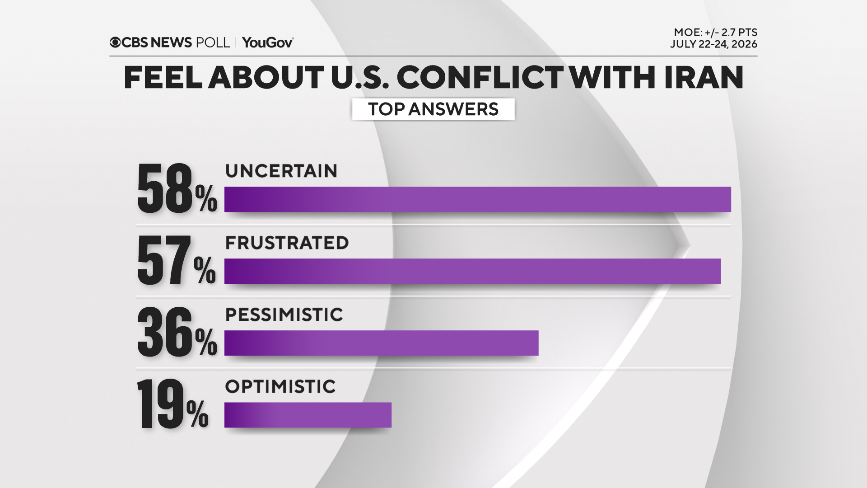
As the Iran conflict persists, Americans express several concerns. Many find the situation in the Strait of Hormuz unclear and believe the U.S. has important objectives to achieve. However, a majority feel the conflict is not progressing well.
Currently, most Americans describe their feelings about the situation as ‘uncertain’ and ‘frustrated.’ They anticipate the conflict could last months or years longer than expected, with many stating it has been more challenging than the Trump administration anticipated.
Primary Public Goals
The public consistently emphasizes the importance of opening the Strait of Hormuz, curbing Iran’s nuclear ambitions, and mitigating threats from Iran in the region. Despite these goals, most believe achieving them will take significant time.
The preference for ending the war holds among many, with less enthusiasm for demanding further concessions from Iran. A previous ceasefire agreement fell through, impacting current sentiment. Republicans, in particular, support the president in allowing the conflict to continue after the failed deal.
Among those advocating for more concessions, the aforementioned goals are especially crucial. Younger individuals, particularly those under 65, are more inclined to desire an end to the conflict compared to older Americans.
Persistent Uncertainty
Uncertainty arises from a perceived lack of information about daily events in the Strait of Hormuz, a situation unchanged over recent months. Many believe President Trump portrays the conflict more favorably than reality suggests.
Overall perceptions of the conflict have deteriorated, with mixed views on which side holds the advantage. Approval of the U.S. actions remains negative yet stable.
Domestic Concerns and Economic Impact
Domestically, the situation mirrors recent trends—income levels are not matching inflation, and many feel the president is not prioritizing price reductions effectively. Tariffs remain unpopular, with many believing the focus on these and changes in D.C. is excessive.
A notable portion of Americans face difficulties due to gas prices, though fewer now regard them as severe hardships. Negative economic sentiments persist but have stabilized recently.Validating these sentiments, inflation-adjusted incomes oppose additional tariffs overwhelmingly.
The president’s approval regarding Iran aligns with past figures, staying lower than overall approval ratings, which have seen a slight increase since June.
Uncertainty persists on political approaches towards Iran. Neither Democrats nor Republicans are perceived as decisive, leaving many with increasing uncertainty about the conflict’s resolution.
This CBS News/YouGov survey was conducted among 2,193 U.S. adults from July 22-24, 2026. The sample reflects the national demographic based on gender, age, race, and education, as well as the 2024 presidential vote. The margin of error is ±2.7 points.
 Trump’s Engagements at the UN: Focus on Ukraine and White House Developments
  Trump Administration to Admit 17,500 Afrikaner Refugees from South Africa
  Trump’s Vision for Global Security: Iran, AI, and the Role of the U.S.
  Concerns Raised Over Canadian Assisted-Dying Program
  Lithuanian President Urges U.S. to Maintain Military Presence Amid NATO Challenges
  Italian PM Giorgia Meloni Skips UN General Assembly Amid U.S. Tensions