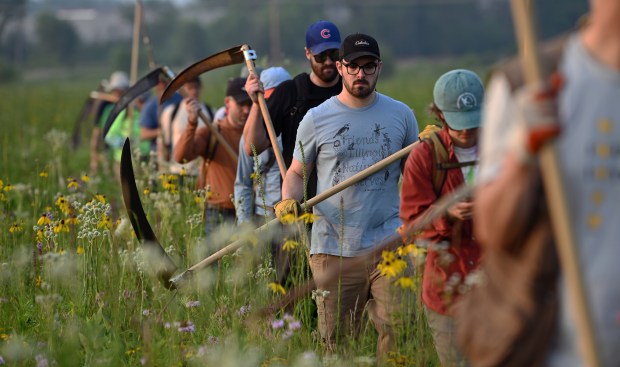
On Saturday, motorists passing by Somme Prairie Nature Preserve in Northbrook might have felt they were witnessing a scene from another era. Nearly 30 volunteers gathered at this location on Dundee Road to engage in a traditional scything event organized by the Friends of Illinois Nature Preserves. Their mission was crucial: cutting down invasive plant species using handheld scythes.
The air quality had improved since the Canadian wildfires, dropping to a moderate 60 rating, allowing dedicated volunteers to proceed with their work around 6 p.m. The focus was to remove invasive species like sawtooth sunflower and tall goldenrod, explained Rebeccah Hartz, a restoration volunteer and assistant director of Friends of Illinois Nature Preserves. She highlighted that these were not woody plants like buckthorn. The scythe, she said, was ideal for this task as it allowed precise cutting close to the ground.
“Scythes are really effective for cutting very low to the ground and very precisely,” Hartz noted.
Volunteers arrived from across northern Illinois, gathering at the Northbrook Post Office before heading to the adjacent prairie. Their workday concluded with a potluck supper on the grass. Among the regular restoration volunteers was Stephen Packard, an author and conservationist who has served as site steward for Somme Prairie Grove. Packard recalled the area’s history when it was a buckthorn-infested woodland. “What happened here, this was all woods,” Packard said. He expressed a desire for faster progress in restoring the prairie.
“No, I want it to go faster,” Packard admitted, though he recognized the positive impact volunteers have had.
Volunteers resorted to using scythes, tools not commonly seen in modern landscaping. Imogene Asa, from Chicago’s Logan Square, briefly paused with her scythe, reflecting on its timeless appeal and practicality. For some, the scythe brought to mind folklore, as noted by Will Uhlemann of Glenview, who associated the tool with the Grim Reaper. Despite this association, the day’s focus centered on nature.
John Jacobs of Evanston expressed admiration for the scythe’s efficiency. He acknowledged technology’s role but emphasized that for this work, the scythe was unmatched. Mick Dart from Highland Park and Jordan Botezatu from Lincolnshire both highlighted the personal benefits of participating in the event, citing mental and physical well-being. Volunteer David Duncan from Ravenswood drew attention to combating sweet clover, an invasive species needing immediate action to prevent seed dispersal.
During the potluck dinner, Christos Economou from Wilmette mentioned the positive impact of contributing to environmental restoration. He highlighted that events like this provide an opportunity to feel optimistic and proactive rather than overwhelmed by environmental challenges.
“This is kind of like playing offense. We’re trying to restore as much as we can,” Economou shared.
 Communities Continuing Recovery from Hurricane Helene Explored through Graphic Novel
 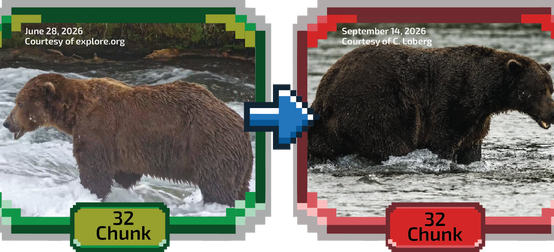 Fat Bear Week 2026 Highlights: Meet the Competitors
 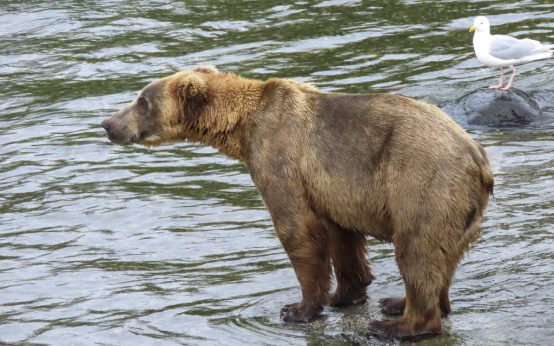 Annual Fat Bear Week Begins at Katmai National Park
  Understanding Hurricane Development
  California Prepares for El Niño-Fueled Storms with Emergency Declaration
  California’s Growing EV Adoption: Challenges and Benefits