Senator Lindsey Graham passed away on July 11th at age 71. The medical examiner indicated an aortic dissection, a tear in the large artery that carries blood from the heart. This condition, often described as sudden, involves a silent onset until a tear or rupture occurs.
What Can Go Wrong in the Aorta
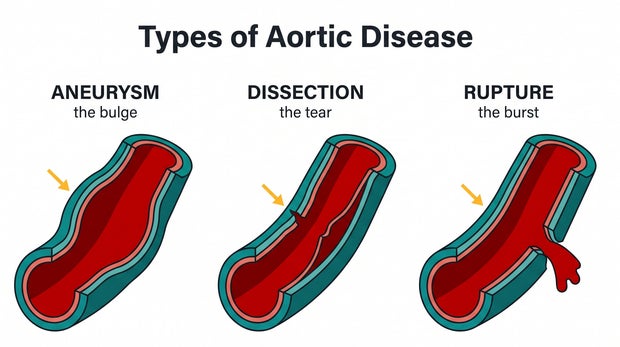
The aorta, the body’s largest artery, extends from the heart through the chest and abdomen. Three key issues affect it: aneurysms, dissections, and ruptures. These are distinct but often confused.
Aneurysm
An aneurysm appears as a bulge from a weak aortic wall stretching over time. It usually presents no symptoms and is often found during unrelated scans. As it expands, the wall weakens, increasing the likelihood of failure.
Dissection
A dissection involves sudden tearing where blood breaches the inner lining, creating a false channel. It does not require an aneurysm first and often results in abrupt pain in the chest or back.
Rupture
A rupture occurs when the aortic wall ruptures completely, causing blood to leak into the chest or heart sac. It often follows an aneurysm or dissection, leading to a potentially fatal situation.
These conditions may be related by one setting off another, yet they differ. Dissection often affects older individuals, linked to high blood pressure and hardened arteries. In younger people, aneurysms frequently have a genetic basis from connective tissue weaknesses.
My Personal Experience
In 2022, my husband Grant Wahl, a journalist, passed away during a World Cup event at 49. His health story was different. Grant’s aortic aneurysm had expanded to 6.0 cm, leading to a burst without prior arterial hardening. An autopsy indicated gradual thinning of his aortic wall.
Why I Requested an Autopsy
As a physician, epidemiologist, and journalist, I could not accept ‘sudden’ as a conclusion. I sought explanations and understanding. The autopsy provided closure. It also discredited misinformation concerning COVID-19 vaccinations, confirming they had no role in the incident.
Genetic Insights from the Autopsy
The medical examiner discovered a variant in Grant’s DNA related to Marfan syndrome. Although Grant did not exhibit the syndrome, this variant likely influenced his aneurysm, highlighting inherited connective tissue issues as critical risk factors.
Prevention Through Knowledge
Identifying the genetic variant allowed other family members to undergo testing. Screening can provide early warnings, as seen with Grant’s brother, Eric, who now monitors his aortic health closely.
Actor John Ritter’s similar fate in 2003 led to the creation of a foundation supporting research and advocacy. Aortic dissection is still often confused with heart attacks. Programs like New York City’s GIFTS offer free genetic testing for families affected by inherited conditions.
Steps for Prevention
When to Seek Screening
Seek screening if a close relative had thoracic aortic disease or if there’s an unexplained sudden family death before age 60. Look for connective tissue disorder traits like extreme height or nearsightedness. Men aged 65 to 75 with a smoking history should request an abdominal ultrasound.
Who Should Consider Genetic Testing?
Those with thoracic aortic issues and connective tissue traits, a family history, or early onset of the disease should consider genetic testing. It helps identify familial risks.
If An Aneurysm is Detected
Aneurysms can be managed with blood pressure control and regular monitoring. Surgery is advised when they reach 5.5 cm, or smaller in genetic cases. Grant’s aneurysm was beyond this mark. Awareness and proactive healthcare can potentially save lives.
If aortic disease is present in your family, inquire about imaging and genetic testing with your healthcare provider. This proactive approach could be lifesaving.
 Challenges Faced by the Family of a Rare Cancer Patient
  Keys to Effective Post-Exercise Recovery for Adults Over 35
  Personal Journey in Understanding Neurodegenerative Diseases
  Artist Speaks Out on Rare Condition Impacting Her Career
  Durham’s HEART Program: A New Approach to Public Safety
  Mindfulness: Manage Stress by Embracing the Present