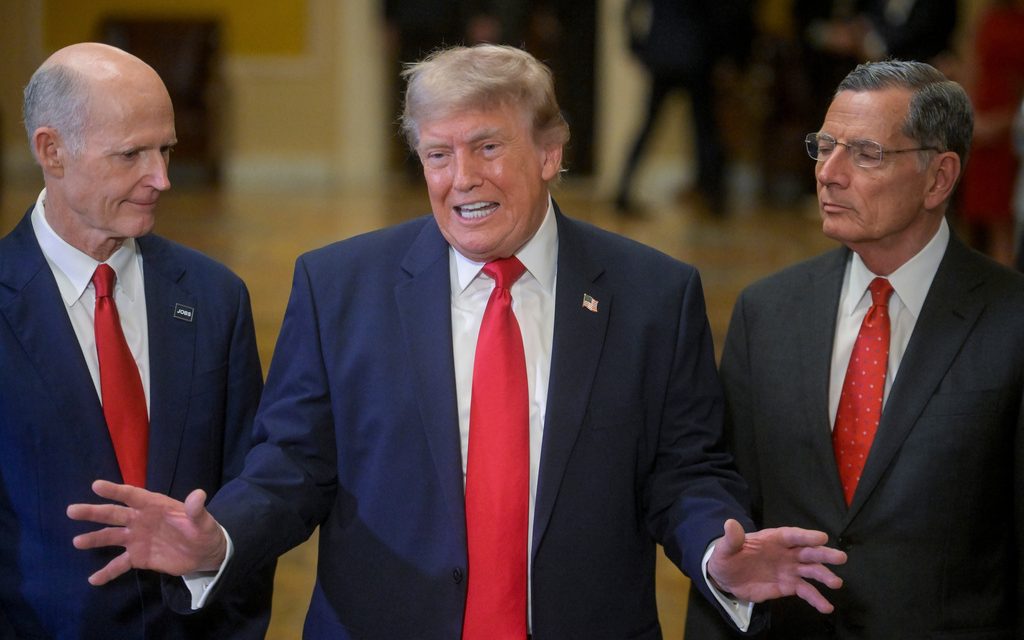
President Donald Trump attended a private lunch with the Senate Republican Conference at the U.S. Capitol on June 24, 2026. During this gathering, he criticized four GOP senators, Susan Collins, Bill Cassidy, Lisa Murkowski, and Rand Paul, for backing a House resolution to prevent U.S. military activities against Iran. The resolution had passed in the Senate with a 50-48 vote.
Trump questioned the senators’ decisions on the war powers resolution. In response, Senator Cassidy, who had recently lost his primary race to a Trump-endorsed opponent, challenged the president. He questioned Trump’s lack of transparency with the American public regarding the objectives in Iran, as a supposed four-week mission had extended to four months. This confrontation led to a heated exchange between the two.
The administration contended that the resolution was unconstitutional, citing the 1983 Supreme Court decision in Immigration and Naturalization Service v. Chadha. This case involved a provision that permitted either house to overturn a deportation suspension, which the court found violated the presentment clause requiring passage by both houses and presidential approval. As a result, Congress adjusted many laws, although the 1973 War Powers Resolution remained unchanged, allowing two-house resolutions to end military hostilities abroad.
Following this dispute, Senator Tim Kaine proposed a joint resolution to halt U.S. military action in Iran. This would need a presidential signature or veto. However, the Senate rejected the motion to consider the resolution with a 47-50 vote. Cassidy voted against it, while Paul chose to vote “present.” Simultaneously, the Senate dealt with Trump’s demand for immediate action on the SAVE America Act election law changes, which he linked to passing a bipartisan housing affordability bill.
Last week, President Trump delayed Jay Clayton’s Senate confirmation for director of national intelligence until his nominee for Clayton’s previous position was confirmed. This tactic of linking bills and nominations to his priorities caused frustration among congressional leaders, affecting Senate scheduling and planning.
In conclusion, internal planning challenges in Congress are reminiscent of the 1941 movie, The Man Who Came to Dinner, with the president described as asserting control over proceedings. The circumstances serve as a reminder of the complexity of balancing legislative agendas with executive priorities.
Don Wolfensberger is a long-serving congressional staff member, having been chief of staff of the House Rules Committee in 1995. He authored “Congress and the People: Deliberative Democracy on Trial” and “Changing Cultures in Congress: From Fair Play to Power Plays.”
 Trump’s Approach to China: Trade Dynamics and Challenges
  Media Outlets Sue After White House Ban
  American Public Opinion on Press Freedom
  Media Lawsuit Against Trump Administration for White House Ban
  The Cost of Challenging Beijing
  Analyzing Midterm Elections and Party Dynamics