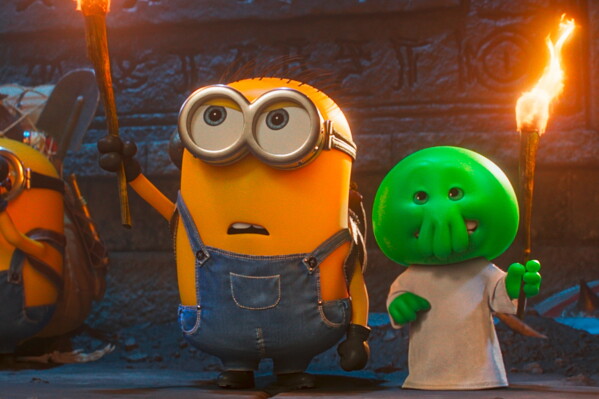
Pierre Coffin, the filmmaker behind the Minions, crafted their unique dialect, Minionese, over time. He began by collecting unusual words and phrases, inspired by everything from Indian dishes to everyday odd words. Finding the right ‘melody’ was his toughest challenge.
Coffin co-directed ‘Despicable Me’ 16 years ago, marking the start of a hugely successful franchise. Both ‘Despicable Me 2,’ ‘Despicable Me 3,’ and ‘Minions’ followed. Despite this success, the Minions, similar to a personal Frankenstein’s creation for Coffin, remained an enigma.
As a French Indonesian animator based in Paris, Coffin faced the complexities of Hollywood franchises. The narrative of a supervillain and gibberish-speaking lackeys posed its own puzzle. He confessed that he distanced himself from the series, as the sequels strayed from his original vision. His sensitivity to the divergence in plotlines made him hesitant to continue.
Coffin expresses, “Even movies that I directed, I’m highly critical of. The previous ‘Minions’ spinoff, ‘Minions: The Rise of Gru,’ I don’t discuss it because it’s strange to me.”
His candidness highlights his mixed feelings about the franchise. After directing ‘Despicable Me 3,’ Coffin felt the need to move on. Despite his break, he’s often drawn back by the characters. Now, Coffin returns for ‘Minions & Monsters,’ intrigued by its fresh concept.
Released on Wednesday, ‘Minions & Monsters’ may surpass previous films. Set in 1920s Hollywood, it involves the Minions trying to make a monster movie, akin to cinema icons like Charlie Chaplin and Harold Lloyd. The premise drew Coffin back, inspiring him to co-write the script with Brian Lynch.
This new film advances the Minions from sidekicks to stars. They resemble silent film protagonists, adding depth to the narrative. According to Chris Meledandri, the film’s story resonates with older audiences who grew up with Minions.
The origins of the Minions highlight their development through trial and error. Initial designs ranged from hulking figures to robotic forms. After several iterations and add-ons like goggles and overalls, the iconic characters emerged.
Crafting Minionese
Despite their simplistic language, Minions present challenges as protagonists. Overuse risks diminishing their charm as auxiliary characters speak their lines in Minionese, while careful adjustments maintain balance. Coffin recognizes when sequences need trimming for auditory appeal.
Coffin, who provides the Minions’ voices, had to adapt their dialogue. Initially improvising, writing coherent scripts became essential. Working with co-writer Lynch, they decided to script the characters’ dialogue in English for clarity.
Coffin sees Minions as more than mere characters, akin to mascots of Illumination, earning significant revenue through merchandise. He acknowledges that interpretations of Minions vary, which can affect their original spirit and personality.
Through ‘Minions & Monsters,’ Coffin explored the roots of friendships. By reflecting on how people met their best friends, he concluded, “The Minions are kids.” This realization shaped the film’s storytelling, portraying Minions as mischievous, spirited children.
 Melanie Griffith Reflects on Wellness Retreat and Career Legacy
  Jennifer Aniston’s Relationship Insights from Relationship Experts
  Kim Kardashian Shares Esophagitis Diagnosis Amid Personal Concerns
  Duncan Sheik, Singer-Songwriter and Broadway Composer, Dies at 56
  Engelbert Humperdinck Reflects on Life-Saving Shoelace During Army Service
  Chad Gilbert of New Found Glory Dies at 45