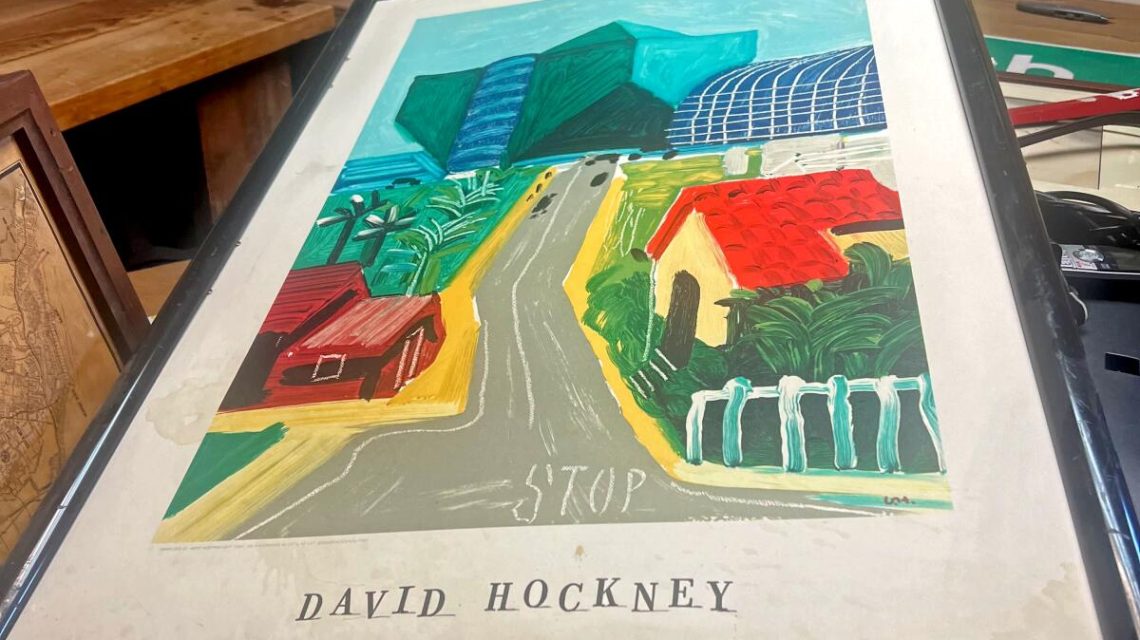
I discovered my first David Hockney print near a run-down Volkswagen Rabbit at an apartment complex carport in West Hollywood. Its aluminum frame was bent, and the print suffered water damage. When I inquired about the price, the garage sale host simply said, ‘name your price.’ In the mid-1990s, Hockney posters inundated Los Angeles. Available at malls, framing stores like Aron Brothers, and Michaels where I later bought his “Nichols Canyon” landscape in a discounted black plastic frame.
Hockney might not have been the greatest artist from Los Angeles, but his popularity was unmatched then. Following his passing, discussions arose about his unique, enduring talent. An artist who made people desire a piece of Los Angeles. The New York Times honored him with the article “How David Hockney Taught Los Angeles to See Itself.” I would assert he taught us to see the L.A. we wanted.
Hockney’s work, such as the abstract panorama of Mulholland Drive and the photo collage of Pearblossom Highway, was everywhere. His posters depicted swimming pools and lush backyards against ocean views. Hockney endorsed mass-market art, mentioning in his memoirs that posters were worth keeping as they could be enjoyed by being pinned to a wall.
In an era shadowed by economic downturns, crime, and natural disasters, Los Angeles bore a different image. Yet amid this, Hockney’s art offered inspiration. In my cramped, dark living space with limited views, his art gave me a glimpse of the Hollywood Hills living dream.
A chance encounter introduced me to Hockney through a stylish neighbor in the fashion industry. His apartment flaunted a large Hockney swimming pool print, complementing his decor. He cherished Hockney’s acknowledgment of the male form and mentioned Hockney’s importance as a gay artist. Embarrassed, I later noticed the figure of a man in white trunks in that print.
Buying Hockney’s print from the garage sale felt like a bonding opportunity with my neighbor. My apartment soon displayed Hockney prints like the geometric blue swimming pool and the layered Nichols Canyon. These pieces attracted my first visitor, the same neighbor, clearly impressed during his short visit.
Reflecting on Hockney’s portrayal of L.A., it may now seem limited. His vision captured certain lifestyles, not the city’s full spectrum. While fewer prints are seen today, and mine are stored away, I still value how Hockney shaped my perception of L.A. and myself.
Despite not achieving the Hollywood Hills mansion dream, I have a suburban backyard pool now. Though often empty, its serene beauty when sunlight reflects off the water keeps dreams alive.