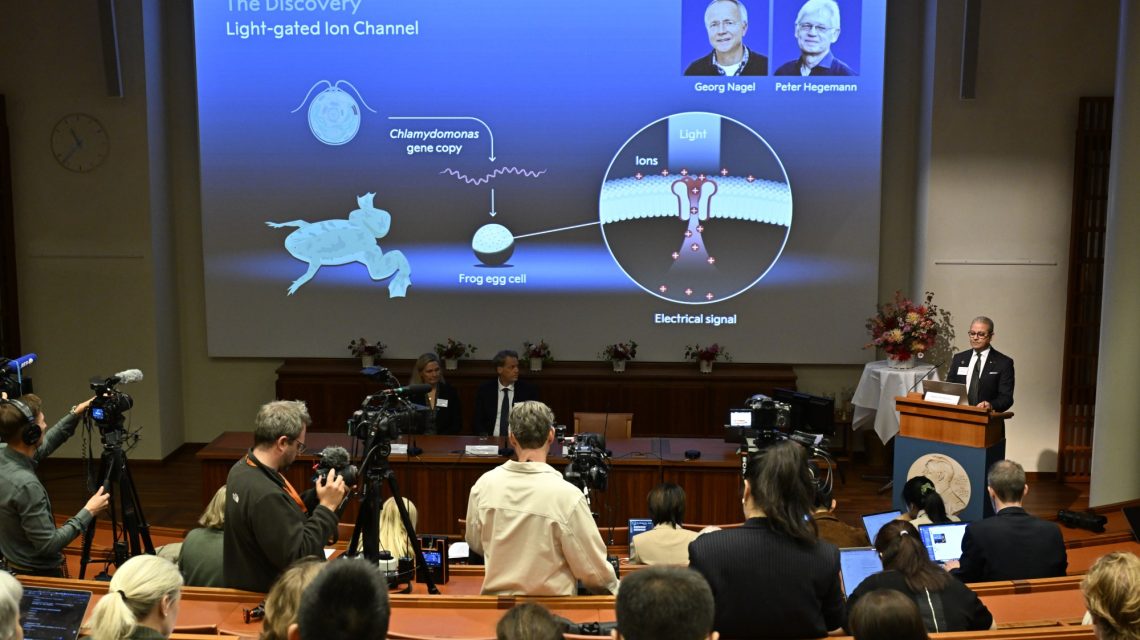
The 2026 Nobel Prize in Physiology or Medicine was awarded to Karl Deisseroth, Peter Hegemann, and Georg Nagel, recognizing their work on mechanisms that regulate nerve cell activity in the brain. Their research focused on light-gated ion channels and optogenetics.
The Nobel Assembly praised their breakthroughs, stating this method is now widely used to explore brain functions. Deisseroth is affiliated with Stanford University, while Hegemann is based at Humboldt University in Berlin, and Nagel at the University of Würzburg.
Deisseroth described the moment he received the call from the Nobel assembly, admitting he was working late in California. He expressed excitement despite not achieving much sleep.
Optogenetics has created new opportunities in neuroscience by offering a method to activate or deactivate nerve cells with light. This approach helps map brain pathways linked to behavior and disease. Hegemann’s initial research showed how green algae respond to light. He and Nagel identified a protein that creates an electrical impulse when exposed to blue light. Deisseroth used this protein in nerve cells, making them sensitive to light and enabling controlled experiments on living mice.
The prize was announced at the Karolinska Institute, marking the start of Nobel week. The $1.2 million prize will be distributed among the winners. The series of prizes includes physics, chemistry, and literature throughout the week, with the peace prize revealed on Friday. The Nobel Memorial Prize in Economic Sciences will close the week’s announcements.
This year’s prize money totals 12 million Swedish kronor, equivalent to about $1.2 million, regardless of the number of laureates.
 The Cost of Grudges and the Power of Forgiveness
  Alan Alda’s Journey Through Career and Health
  Efforts to Combat Obamacare Fraud Intensify
  Potential Link Between Voice Disorders and Dementia Risk
  Understanding Misperceptions and Inaction in Sexual Assault Prevention
  Study Highlights Risks Associated with Borg Drinking Trend on U.S. College Campuses