On March 12, Alabama plans to execute Charles “Sonny” Burton, a 75-year-old man convicted for his role in a 1991 robbery that resulted in a fatal shooting, despite not being the triggerman. Governor Kay Ivey announced the decision, which uses nitrogen gas for the execution. Burton’s conviction stems from his involvement in the robbery where Doug Battle, a customer, lost his life at an AutoZone store in Talladega.
Though Burton was not physically present during the shooting, prosecutors identified him as orchestrating the crime, pushing for a death sentence. The shooter, Derrick DeBruce, initially faced a death penalty but later had his sentence commuted to life in prison, where he passed away.
Several individuals, including Battle’s family members and trial jurors, have appealed for clemency, arguing the injustice in executing Burton while DeBruce received a lesser punishment. Burton’s attorney, Matt Schulz, expressed disappointment in the scheduled execution, holding out hope for a change in Governor Ivey’s stance, similar to Oklahoma Governor Stitt’s action in a previous case.
Despite a clemency petition, Attorney General Steve Marshall’s office has opposed the request. In previous statements, the conviction and sentence have consistently been upheld by the judicial system. However, Schulz referenced a 2015 state court argument highlighting the potential injustice of upholding Burton’s death sentence without doing so for DeBruce.
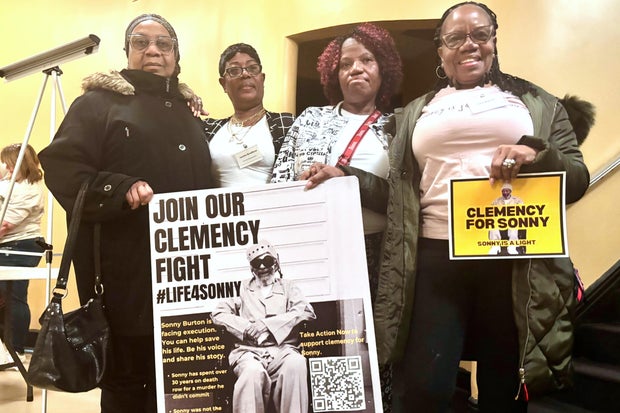
Eddie Mae Ellison, Jackie Bradford, Mary Bradford, and Lois Harris
held signs urging Alabama Gov. Kay Ivey to grant clemency for their family member Charles “Sonny” Burton
on Jan. 28, 2026 in Montgomery, Ala. Kim Chandler / AP
Governor Ivey has rarely granted clemency, with only one instance since 2017. The jurors from Burton’s 1992 trial remain divided on the death sentence decision. Out of the eight surviving jurors, six expressed no objection to commutation, with three actively campaigning for it. Priscilla Townsend, one of the jurors, commented on the emotional nature of the trial and her shift in perspective on the case.
Townsend noted that had the shooter received a lesser sentence, the jurors might have opted differently. Reflecting on her involvement, Townsend penned an essay in which she recanted her previous belief in the portrayal of Burton as the “ringleader,” acknowledging a shift in understanding over the years.
The situation sheds light on the broader legal landscape, highlighting that in twenty-seven states, individuals can face execution for their involvement in felonies that result in death, regardless of whether they directly caused the fatality. This fact is backed by data from the American Civil Liberties Union.