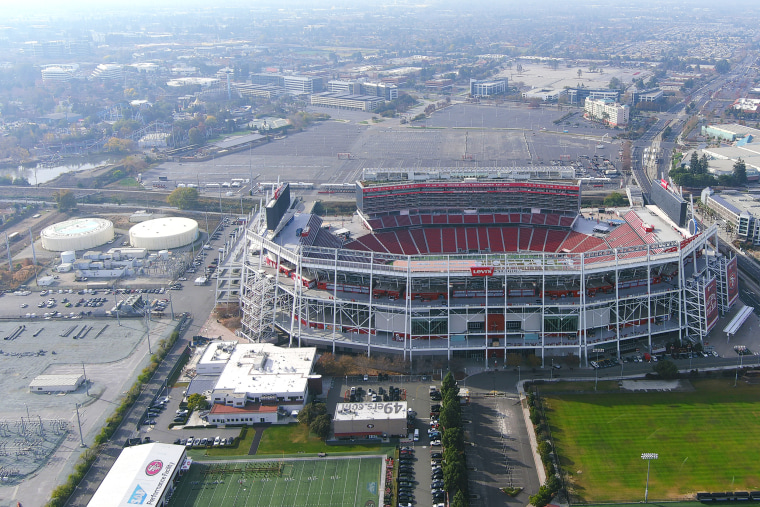
In Santa Clara, California, just a brief distance from Levi’s Stadium, home of the San Francisco 49ers, lies an electrical substation. This piece of infrastructure, typical across the United States, has unexpectedly become infamous. The divisive discussion centers on whether it could be linked to the 49ers’ injury-laden season.
Electrical substations, like the one near the stadium, are scattered across the country, forming a critical part of the electrical grid by managing the flow of electricity. However, the particular substation near the 49ers’ practice area has become the center of a theory blaming it for the team’s spate of injuries.
This theory, initially an inside joke among team members, quickly caught public attention and found traction on social media. Despite the lighthearted origin, the narrative has gained enough momentum for 49ers’ General Manager John Lynch to consider examining the potential validity, although the NFL’s chief medical officer remains skeptical about the substation posing a real threat to player health.
Interestingly, neither of the teams participating in the upcoming Super Bowl are utilizing the 49ers’ practice facilities. Instead, the New England Patriots are using facilities at Stanford University, around 20 minutes away, while the Seattle Seahawks have chosen San Jose State University for their preparations.
“Substations emit low-frequency electromagnetic fields, similar to nonionizing radiation from devices like microwaves and cellphones,”
explains research on electromagnetic fields. While ionizing radiation, as seen in X-rays, is known for its potential to damage DNA or cells, nonionizing radiation is generally deemed harmless in this regard. The World Health Organization supports this stance, finding no conclusive evidence that exposure to these low-frequency fields poses a health risk.
Despite this, some speculate—without scientific backing—that the substation’s electromagnetic emissions might impact players negatively by compromising their tissues and tendons. Over the past season, the 49ers dealt with numerous injuries among key players. Notable incidents included George Kittle tearing his Achilles, Nick Bosa suffering an ACL tear, Fred Warner breaking his ankle, and Brock Purdy’s extended absence due to a toe injury.
Seattle Seahawks’ tight end Eric Saubert, who played for the 49ers in 2024, recounted the substation as a source of humorous speculation among players, although nobody seriously believed it posed any danger. He mentioned the sight of dead trees near the substation added an aura of mystery, fueling half-joking narratives about its effects.
Meanwhile, former 49ers quarterback Josh Dobbs, now with the Patriots, noted the substation’s conspicuous presence upon joining the team. Despite skepticism, he acknowledged that the violent nature of football makes thorough investigation into such claims warranted.
Patriots linebacker Christian Elliss suggested the challenge of debunking this theory, likening it to an urban legend that gains momentum simply through repeated speculation.
As the narrative continues to coil around the 49ers’ recent misfortunes, both fans and players grapple with the blending of folklore and the harsh realities of injuries inherent to professional football.
 France Clinches Gold in Ice Dance, USA Secures Silver
  Chock and Bates Aim for Olympic Gold in Ice Dance
  Lindsey Vonn’s Recovery Journey After Olympic Crash
  Jordan Stolz Wins Gold and Sets Olympic Record in 1,000-Meter Speedskating
  Ongoing Search for Savannah Guthrie’s Missing Mother Nancy Guthrie
  Wasserman’s Position in LA Olympics Amid Scrutiny