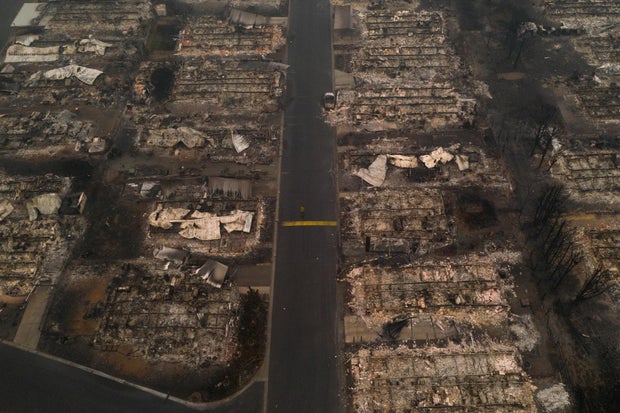
On September 10, 2020, the Almeda Fire ravaged Southern Oregon’s Rogue Valley, destroying thousands of homes. This devastation not only left behind a charred landscape but also exacerbated a housing crisis in an already strained rental market.
ADREES LATIF/REUTERS
Jacob Fry, an artist and contractor, along with his wife, Elize, escaped the flames. Motivated by the need for community aid, they acquired a loan to construct two modest rental units in their own backyard. Their initiative wasn’t aimed at income generation. Jacob emphasized, “It was more about the community and the need for infill housing for displaced individuals.” These units, termed Accessory Dwelling Units (ADUs), are secondary homes built on the same property as a main residence, often in a backyard. Known also as granny flats, carriage houses, or mother-in-law suites, ADUs have become easier and cheaper to install due to recent reforms.
The Frys’ ADUs are now homes for young families starting out. In California, laws now permit at least three modest units on a single-family lot, exclusively for long-term tenants—which excludes platforms like Airbnb. According to Dana Cuff, a professor at UCLA and advocate for the original legislation, more than 82,000 building permits have been approved in California. Cuff, who resides in an ADU constructed in her own backyard, notes a shift in housing development. With limited space for suburban expansion, there’s been a pivot toward urban infill housing, benefiting the environment and the housing market.
CBS News: Dana Cuff in her ADU
Despite the growing popularity, ADU projects face “not-in-my-backyard” opposition. Concerns include strained infrastructure, as services designed for single-family homes extend to support additional units.
Post the Oregon fires, the Frys embraced the opportunity to develop ADUs on their property. Jacob humorously reflects, “If you want to test your marriage, build an ADU!” Their project not only fortified their relationship but nearly offset its expenses with rental income. They rent the units at below-market value to maintain affordability for tenants.
Current tenants, Kaetriauna Bowser-Smith and Jared Weber, appreciate their 400-square-foot dwelling. “It’s perfect,” Bowser-Smith stated. The couple, along with their daughter, has lived contently in the ADU for nearly three years. Bowser-Smith observed the lack of comparable options in the market.
“I don’t feel cramped at all. I feel like I have a lot of space for one old lady!” – Mona Field on her ADU
Down the coast in Los Angeles, 72-year-old Mona Field converted her garage into a two-bedroom ADU, not for tenants, but for herself. Her decision stemmed from a desire to age comfortably in a compact space while offering her primary residence to her daughter and family.
The question of cohabitation arose for her family. “Would we be able to cohabitate on the same property in a functional way?” inquired Charlie Marshak, Mona’s son-in-law. Successfully, they maintain harmony, regularly enjoying family meals and shared activities.
This shift underscores a broader trend. Traditional suburban ideals—homes with white picket fences and expansive garages—are evolving. Housing needs surpass car amenities; every square foot counts. ADUs offer a new living arrangement for contemporary needs.
As Dana Cuff articulated, “We have to start imagining new ways of living together well.”
For more information: Dana Cuff, professor, Architecture and Urban Design, UCLA
Accessory Dwelling Units (American Planning Association)