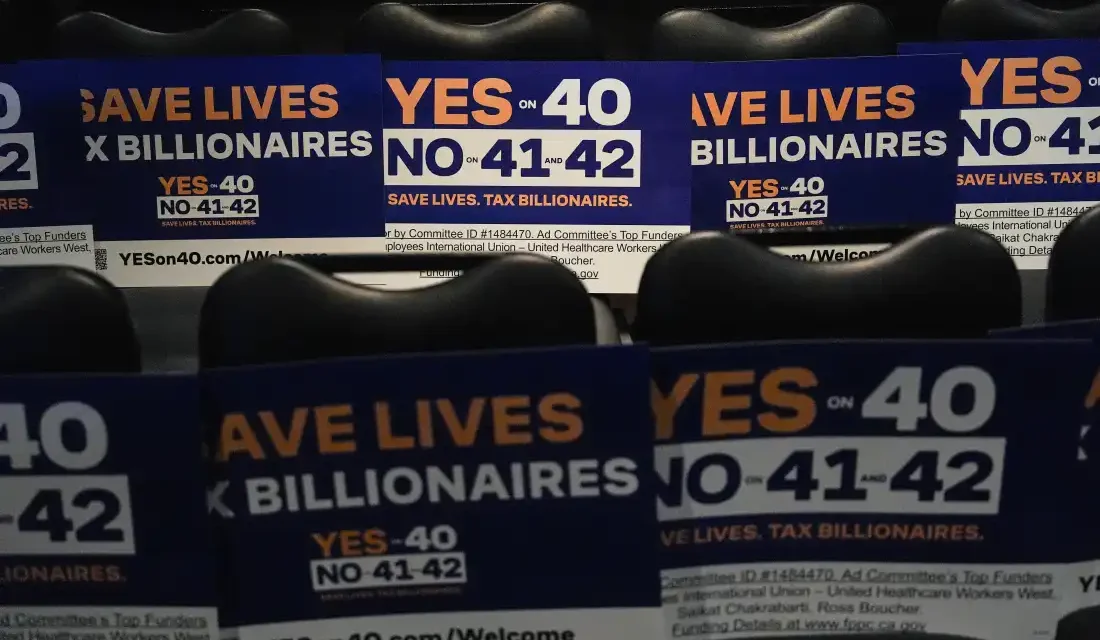
California voters have turned down Proposition 40, a proposal to impose a one-time 5% tax on billionaires’ wealth. The Associated Press announced the results, indicating the measure would not proceed.
Advocates believed the tax could generate $100 billion, primarily for healthcare funding. This initiative was led by the SEIU-UHW, a union representing healthcare workers. They argued that a Republican-controlled Congress had reduced healthcare spending in favor of tax cuts for the wealthy. Thus, they sought to address this disparity through the proposed tax.
The state of California hosts over 200 billionaires, according to estimates. However, some projections suggest this number could be higher. Opponents of Proposition 40 argued that such a tax would drive wealthy individuals out of California, reducing state revenue and negatively impacting its economy.
This measure caused a split among Democrats in a predominantly Democratic state. The state Democratic Party and figures such as Rep. Ro Khanna, D-Calif., and Sen. Bernie Sanders, I-Vt., supported the tax. Both Khanna and Sanders actively campaigned for it. However, Democratic Governor Gavin Newsom opposed the proposition, advocating instead for a nationwide wealth tax. The Democratic gubernatorial candidate, Xavier Becerra, also stood against it.
A major teachers’ union opposed Proposition 40, noting that only a small share of the revenue would have gone to schools. In addition, a significant campaign led by Sergey Brin, Google co-founder, opposed the measure through substantial spending. This opposition outspent supporters by at least five times.
Brin also spearheaded campaigns to introduce two other ballot measures aimed at preventing the implementation of the billionaire tax if approved.
 UFC’s Dana White Declines White House Press Secretary Role Amid Vacancy
 Stephen Miller’s Influence and Controversies
 Hikers Stranded Overnight in Olympic National Park Due to Severe Storm
 Kristi Noem’s Controversial Boast and the Reaction It Sparked
 Trump’s Response to Vance’s Criticism Amid Iran War Controversy
 Midterm Results Impact GOP Senate Seats Vulnerability in 2028