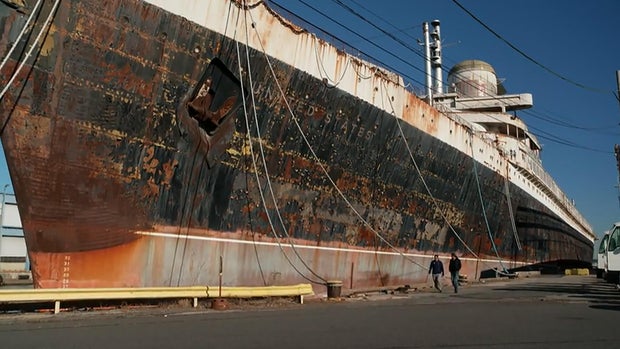
By November 8, 2026, the SS United States, once the queen of the North Atlantic, now sits worn and rusting, yet still captivating. This ocean liner, over five city blocks long and 12 stories high, broke maritime records with its maiden voyage in 1952, reaching speeds over 40 miles per hour. This remains a record for transatlantic crossings.
Beyond her speed, she was the epitome of elegance, carrying four U.S. presidents, numerous celebrities, and thousands of passengers. However, as air travel became prominent, the ship was retired in 1969. Since then, she has been stationed in Philadelphia, largely forgotten.
Despite her decline, her charm endures. Susan Gibbs, president of the SS United States Conservancy, understands this allure well. Her grandfather, William Francis Gibbs, designed the ship. Funding by the U.S. military allowed it to be rapidly converted into a troop transport.
Originally majestic, the ship’s grandeur has faded. Today, only her structure remains, with an empty staircase, a derelict pool, and a bare dance floor. Still, Gibbs is determined to preserve her legacy despite various unsuccessful proposals.
The ship seemed destined for scrapping until a novel plan emerged. Alex Fogg proposed transforming her into the largest deliberately-sunk artificial reef. As a natural resource chief in Okaloosa County, Florida, Fogg has experience creating artificial reefs by sinking smaller vessels.
This project involved substantial challenges due to her two massive engine rooms. For Jennifer Adams, tourism director for Okaloosa County, the ship presented an opportunity as a tourist attraction. She acquired the ship for $1 million, with another $13 million needed for preparation.
There were challenges, including environmental contaminants from the 1950s. Additionally, fans like Linda Sylva and Joe Beaman hold deep connections to the SS United States. Even those like Jeffrey Smith, who never sailed on her, feel drawn to say farewell.
In 2025, fans bid adieu as she departed Philadelphia, her funnels skimming under the Walt Whitman Bridge. Despite her age, she cut through the waves with grace. She arrived ahead of schedule, reminding everyone of her record-setting past.
Once at a Mobile, Alabama shipyard, extensive cleaning took place to remove harmful elements. Engineers cut holes into her structure to facilitate controlled sinking. Her iconic funnels will be preserved and featured in a planned museum by the SS United States Conservancy.
As she prepares to rest 20 nautical miles off the Florida coast, fans anticipate her new role as a marine habitat. This act seems counter to her original purpose, yet it ensures her place in maritime history. For many, she is finally home at sea.
 Neighborhood Heroes Rescue Family from Florida Flooding
 Reflecting on Marriage and Divorce: A Journey to Sun Valley
 Florence Meiler: Breaking Records at 91
 Marathon Highlight: A Pregnant Runner’s Unexpected Journey
 Caring for a Parent in Memory Care: A Personal Journey
 Celebrating National Bowling Day and Remembering Ritsuko Nakayama