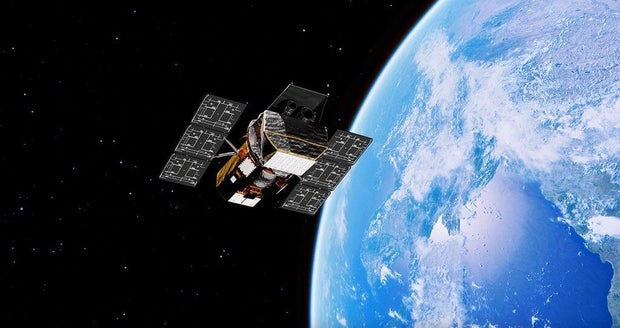
The Swift Observatory, a 1.5-ton NASA telescope, has reentered Earth’s atmosphere. Efforts to save it failed earlier this year. The observatory entered the atmosphere at 7:39 a.m. ET over North Sumatra, Indonesia. Most of it burned up on reentry, but some parts may survive and be found across hemispheres according to NASA.
The reentry path of the telescope was tracked by NASA and the U.S. Space Force. The reentry time was predicted at around 3:30 a.m. EST on November 4, with a possible variation of 11 hours. NASA had stated earlier that the possibility of harm to people on Earth was low, estimating the odds at about 1 in 2,100.
Launched on November 20, 2004, the Swift Observatory’s mission was to detect massive galactic explosions, like gamma-ray bursts and supernovas. Named for its ability to quickly respond to such events, the telescope was supposed to complete a two-year mission but continued for nearly 22 years until solar activity brought it down.
NASA had contracted Katalyst Space to attempt to save the telescope with a three-armed robot named Link. The robot faced difficulties after launch and could not get closer than seven miles to the telescope, ultimately falling back to Earth in September. By late August, the decision was made to let the observatory descend back to Earth.
The telescope ceased its operations and shut down in late October as it dipped too low to function correctly. During its operational life, the Swift telescope detected over 2,000 gamma-ray bursts and 1,400 exploding stars. It also acted as a ‘first responder’ sending alerts to the Hubble and Webb space telescopes for further examination.
NASA stated in a blog post that Swift expanded knowledge of numerous cosmic phenomena, from galaxies driven by supermassive black holes and X-ray flares from stars to supernovae and objects within our solar system.
Researchers are currently exploring ways to replace the vital function the Swift observatory served. John Nousek, an astronomer from Pennsylvania State University who led the control team, acknowledged the inevitability of this outcome. Nousek remarked, ‘Our fervent hope is that the lessons learned by the successes of Swift can be applied to new generations of space missions to accelerate our discoveries about the universe.’
 Meteor Lights Up Skies Over North Carolina and Tennessee
 Can AI Possess Consciousness and Emotion?
 NASA Opens Applications for Aspiring Astronauts
 Scrutiny and Leadership in Focus
 NASA Seeks Next Generation of Astronauts for Moon and Mars Missions
 Restoring Confidence in American Scientific Careers