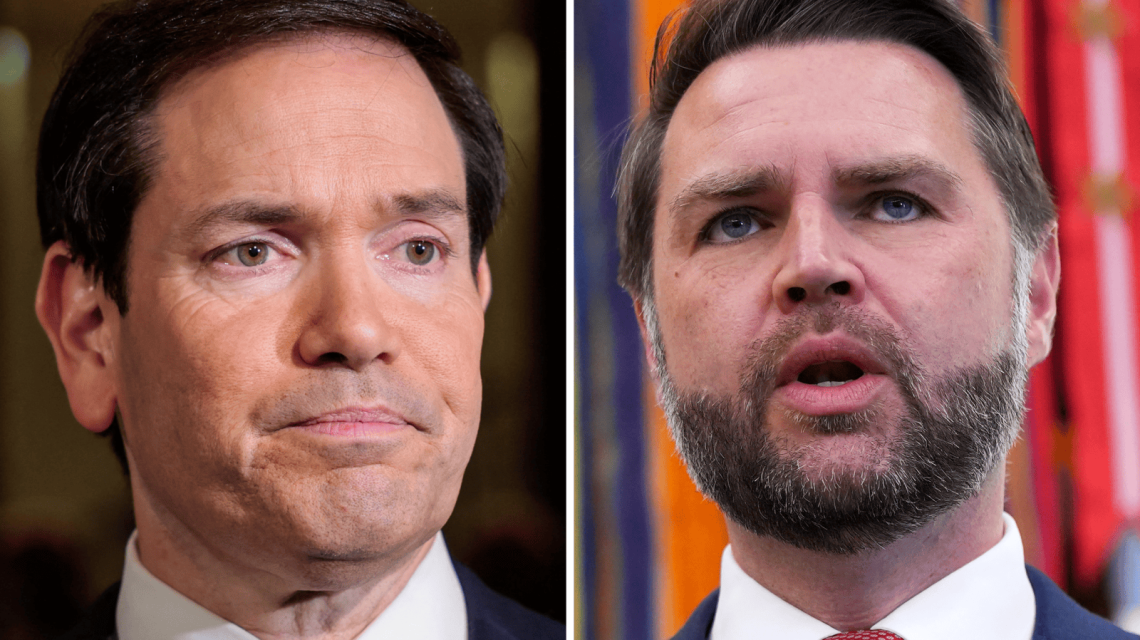
Vice President JD Vance and Secretary of State Marco Rubio are experiencing a decline in their odds for the 2028 Republican presidential nomination, according to recent data analyzed by Newsweek from Polymarket and Kalshi.
On Polymarket, which has seen almost $714 million in trading volume, Vance’s odds dropped from approximately 53% on September 3 to 43.8% recently. Rubio’s odds decreased from 27.8% on August 3 to 15.1%. Kalshi’s data, albeit with less dramatic figures, shows a similar trend. Vance’s odds dropped from 45.8% to 43%, and Rubio’s from 29.5% to 18%, with nearly $70,000 traded.
Vance’s decreased odds followed his weekend acknowledgment of the possibility that he may not run for the presidency due to family considerations. This movement in prediction markets raises questions about Republican confidence in their post-Trump succession plan. However, Koleman Strumpf, an economics professor at Wake Forest University, warned against overemphasizing the shift, noting that only part of Vance’s drop followed his comments.
Strumpf indicated the absence of a clear beneficiary in the market’s adjustments. While alternatives like Florida Governor Ron DeSantis and Tucker Carlson remain with minimal odds, Rubio is also seeing declining interest. Strumpf suggested that traders might not view Vance’s remarks as particularly significant.
Potential Midterm Election Impact
Costas Panagopoulos, a political science professor at Northeastern University, highlighted that any Republican closely associated with Trump might be cautious about the 2028 prospects. He argued Republican losses in the 2026 midterms could negatively impact the administration’s perceived appeal.
Thad Kousser, from the University of California, San Diego, emphasized that Rubio and Vance had thrived politically due to their ties to Trump. He noted that if the midterms are unfavorable for the GOP and Trump, their association could become a disadvantage.
The midterms might determine future Republican strategies. Panagopoulos highlighted potential GOP challenges if Democrats achieve significant wins in typically Republican states or have narrow victories in established Republican regions.
Market Insights and Limitations
Keith Gaddie, holding the Hoffman chair at Texas Christian University, pointed out that prediction markets should not be equated with public opinion polls. He explained that market fluctuations may reflect traders’ hedging actions rather than voters’ preferences.
Strumpf countered that high-profile contracts with heavy trading, such as Polymarket’s, provide a reliable forecast. He noted ongoing trades indicate continuous updates, although prediction markets do not equate to Republican voter consensus.
The prediction market unveils rising uncertainty surrounding Vance and Rubio. However, to establish a substantial shift in Republican sentiment, evidence of voter, donor, endorsement, and candidate movements would be necessary.
 JD Vance Discusses Potential 2028 Presidential Run and Trump’s Endorsement
 Contentious Ohio Governor’s Race Intensifies
 International Political Support and U.S. Election Discussions
 Pelosi’s Influence in San Francisco’s Political Transition
 Expenditure on Surveillance Amid Controversy Over Lincoln Memorial Damage
 Roger Marshall’s Quest for a Second Senate Term and His Personal Journey