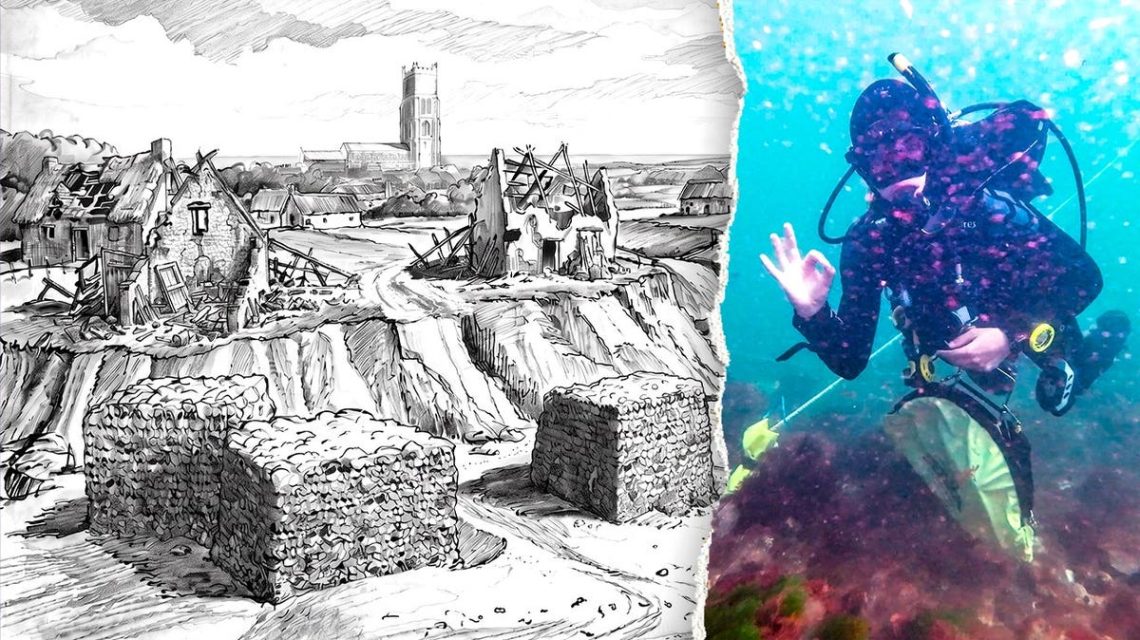
Recent diving explorations have unveiled intriguing underwater structures off the coast of Norfolk, United Kingdom. These are believed to be remnants of a medieval village called Shipden, which disappeared under the waves around 700 years ago.
The Lost Town of Shipden
Shipden, once a thriving medieval settlement, was ultimately claimed by the North Sea. Volunteer divers from the East Anglian branch of the British Sub-Aqua Club (BSAC) surveyed the site as part of the Alfred Savin Project. They photographed and mapped 25 man-made features.
Findings included stone structures covered with marine life, along with flint and other cut stones used as building materials in medieval times. Among them were the remains of foundation structures known as caissons. These possibly formed part of a 14th-century effort to protect the village from the sea’s advance.
Historical Context
According to the Domesday Book, Shipden had 117 residents in 1086. The town featured three acres of meadow, a harbor, two churches, and woodland supporting 36 pigs. By the 14th century, it faded from records as the area was rebranded as Cromer. Historical documents confirm a church was lost to the sea, although no identifiable remains have been found beneath the waves.
Exploration and Discoveries
Nick Schiller, lead diver, mentioned that the team initially sought remains of the vessel Victoria, wrecked in 1888. However, uncovering Shipden’s details became an additional success. Findings imply that Church Rock, once believed connected to St. Peter’s Church, may be medieval sea defenses instead.
Peter Stibbons, chair of the Friends of Cromer Museum and project director, stated researchers are now utilizing medieval records alongside these physical discoveries. This approach aims to deepen understanding of Cromer’s historical narrative. As further examinations proceed, the story of Shipden continues to unfold.
 Homes Evacuated Near RAF Fairford in Explosives Investigation
  Hungary’s New Government: Policy Shifts and International Relations
  Major Incident Declared Near U.K. Airbase Used for U.S. Military Strikes
  Xi Jinping’s Quest for Global Leadership and Succession Challenges
  Pope Leo XIV Draws Massive Crowd in Paris, Highlighting Enduring Catholic Influence
  Pacific Hurricanes Pose Flood Risk to Southern California