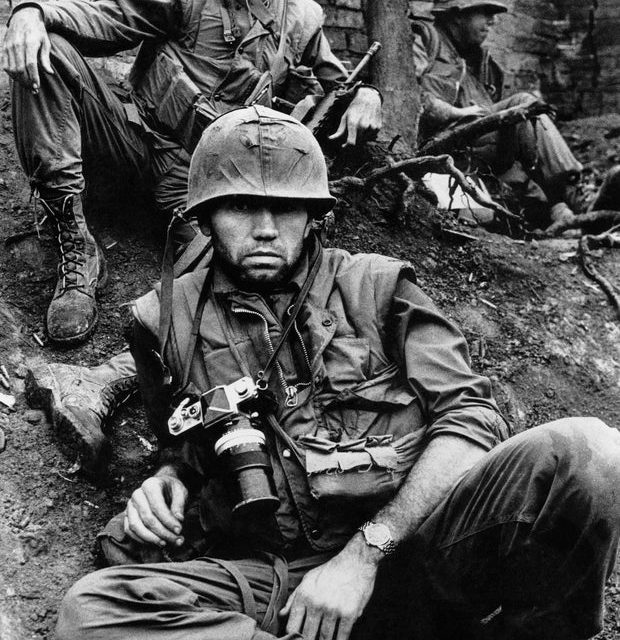
“I want my pictures to hurt you. I don’t want you having any free rides. I’m there to upset you and make you feel uncomfortable the way I feel when I go to bed at night.” British war photographer Sir Don McCullin shared these thoughts with CBS News ahead of releasing what he calls his final book. For over 50 years, McCullin documented conflicts worldwide, including those in Cyprus, Biafra, Israel, Lebanon, Afghanistan, and Northern Ireland.
At 90, McCullin is about to publish a retrospective focusing on a defining conflict of his career: Vietnam. The book features thousands of images he captured during assignments in Vietnam throughout the 1960s and early 1970s.
McCullin’s work includes some of his most iconic images, complemented by never-before-seen photographs. These images document the harrowing events that still deeply affect the American psyche. They expose the violence suffered by innocent civilians and the fear and exhaustion experienced by the U.S. Marines with whom McCullin was embedded.
The 1968 Battle of Hue, part of the Tet Offensive, is central to the book. McCullin described the difficulty of the situation. “It was amazing any of us survived,” he said. A senior officer had predicted a 24-hour operation; however, it lasted 11 days. In Hue, McCullin captured “Shell-shocked US Marine,” an image of a motionless soldier clutching his rifle and staring blankly into the distance.
“I made five frames of this soldier sitting there, and not once did his eyelashes move,” McCullin recounted.
Despite the image’s fame, McCullin remains uneasy about it. “Frankly, I hate this picture,” he stated, feeling it overshadowed his other work. He believes that making such images iconic can make them bearable to view, which isn’t suitable because it stops people from confronting the harsh realities of war.
The book also shows how war photography sometimes blurs the line between observer and participant. McCullin recalled photographing a severely wounded Marine pinned down by enemy fire. He then intervened, carrying the Marine to safety.
“I said, ‘Bring him to me,’ and I put this Marine on my back, and I ran him away to safety,” he described.
The battle’s memories still haunt McCullin. “To this day, I live that battle every night,” he admitted, although he neither wants nor expects sympathy. McCullin’s career is nearing its end, and “Vietnam” stands as a historical record and personal farewell. The book is more than a collection of photographs. It is a testament to a lifetime spent witnessing suffering and a reminder of his belief that photography should challenge and disturb.
All images in the feature are © Don McCullin and featured in the book “Vietnam,” published by GOST Books.
 Rep. Alexandria Ocasio-Cortez Defends Macklemore Amid Tour Controversy
  Google Fined for Breaching EU Privacy Rules
  South China Sea Tensions Rise after Collision between Chinese and Philippine Ships
  North Korea’s Hypersonic Weapon Test Amid Global Tensions
  Austin Tice: A Search for Answers
  U.S., Denmark, and Greenland Forge New Security Agreement