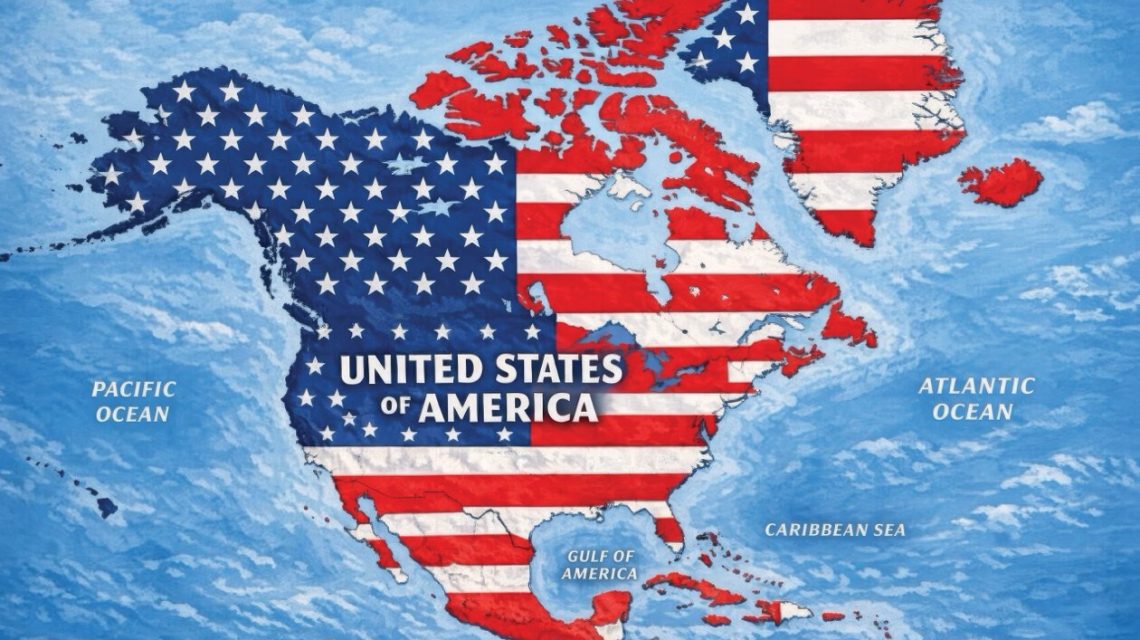
President Donald Trump shared a map on Truth Social that seemed to include all of North America as part of the United States, reigniting tensions with Canada amid ongoing trade disputes. The AI-generated image is seen by some as a nod to the White House’s ‘America First’ policy, reminiscent of the Monroe Doctrine’s historical influence.
The trade conflict deepened as Trump intensified disagreements with Canada. Economic issues aren’t the sole point of contention. Trump has previously referred to Canada as the 51st state and expressed ambitions regarding Cuba, Greenland, Mexico, and the Panama Canal. His administration’s renaming of geographical locations, such as the Gulf of Mexico to the Gulf of America and Lake Ontario to Lake America, underscores these tensions.
Unresolved Territorial Disputes
Several territorial disagreements persist between the U.S. and Canada. These disputes predate Trump’s leadership and remain unresolved, contributing to the tension between two NATO members. Rob Huebert, director of the University of Calgary’s Center for Military Security and Strategic Studies, expressed concerns about the Trump administration’s disregard for the unity previously achieved.
“Many Canadians are uncertain about the Trump administration’s intentions due to its dangerous policies towards Canada,” Huebert warned. “Canada is focusing more on unilateral defense capabilities.”
Arctic Relations
The Beaufort Sea disputes encompass a large area believed to contain significant oil and gas resources. Disagreement on the maritime boundary between Alaska and Canada’s Yukon and Northwest Territories stems from different interpretations of an 1825 treaty between Russia and Great Britain.
In September 2024, Washington and Ottawa announced a joint task force for negotiation, but no meeting followed the initial talks. The Northwest Passage remains another point of contention, with the U.S. viewing it as an international strait, while Canada claims exclusive rights. Climate change has heightened the passage’s value and interest.
Both nations are wary of intensified activities from Russia and increased interest from China in the Arctic. Trump’s threats regarding Greenland, part of Denmark, amplify concerns over Arctic security. Research chair Adam Lajeunesse emphasized Canada’s significant Arctic capabilities but noted potential negative impacts of disputes.
Disputed Maritime Boundaries
Further disputes involve the Machias Seal Island near the Bay of Fundy and areas in Pacific waters connecting the U.S. mainland to Alaska. These involve interpretations of historical treaties and the extent of maritime boundaries.
“There is no good reason for reviving these disputes,” Michael Byers said. “They are well-managed, and Canada would be willing to negotiate.”
International Reactions
Prime Minister Mark Carney rallied Canada against Trump’s latest provocations, including the expanded map and a cartoon depicting Trump defeating Carney in a hockey match. Carney retaliated economically with tariffs on U.S. goods.
“Canada is a nation forged in adversity,” Carney stated. “American tariffs won’t break us.”
Trump responded with threats to ban Canadian products unless manufactured in the U.S. Prime Minister Claudia Sheinbaum of Mexico reaffirmed her country’s independence, while Denmark and Iceland criticized Trump’s map as disturbing.
International diplomacy faces challenges amid these confrontations, reflecting broader geopolitical implications.
 Record Number of Native American Candidates in Elections
  Attempted Hijacking on FlyDubai Flight to Tel Aviv
  Unexpected Senate Race Dynamics in New Hampshire
  Controversy Over Judges Assigned to Trump Cases
  Former Congressman David Rivera Sentenced to 10 Years in Federal Prison
  America First Global Health Strategy and Its Implications