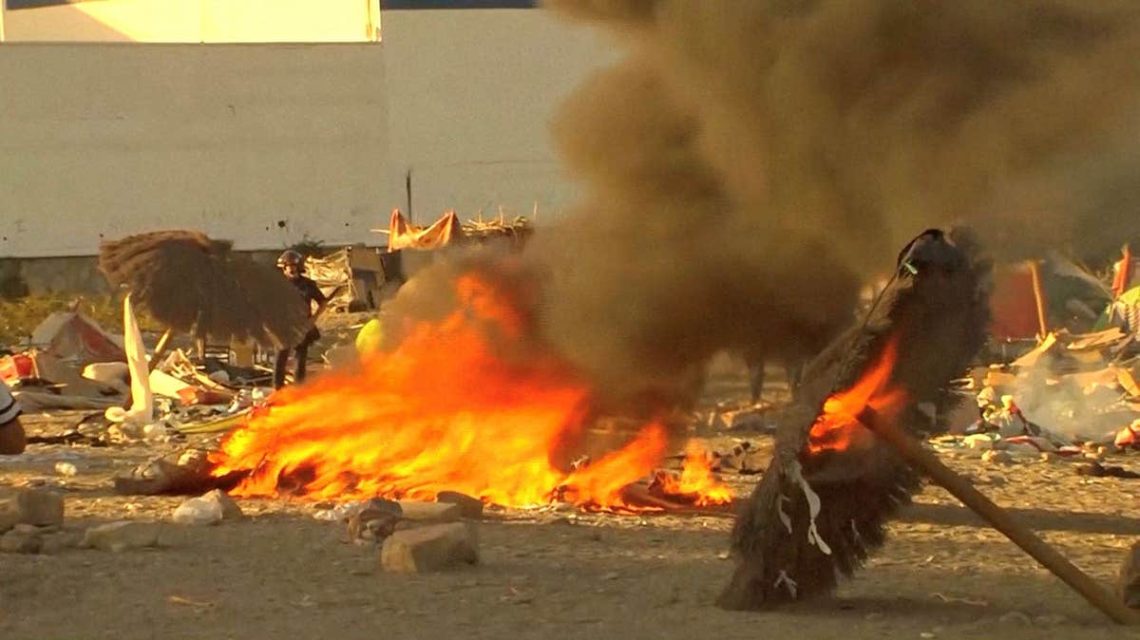
Residents in Spain’s North African enclave of Ceuta dismantled and burned temporary shelters set up by migrants as tensions heightened over an influx from neighboring Morocco. Prime Minister Pedro Sánchez blamed networks linked to Russia and Israel for spreading disinformation that fueled the crisis.
Last week, demonstrators carrying Spanish flags moved toward migrant camps by the beach, destroying shelters and starting fires. Police worked to separate the protesters and migrants. Chants of ‘Invaders, expulsion’ were heard as they advanced, according to reports by Spain’s public broadcaster RTVE and news agency EFE.
The protests continued the next day with hundreds of residents marching again toward areas along the beach. The unrest followed a surge on July 30 and 31 when over 72,000 migrants crossed irregularly from Morocco into Ceuta. Ceuta authorities reported that at least 100 people died during this crossing, and 5,000 migrants remained in the enclave as of Monday.
Disinformation Accusations
Sánchez directly connected the high number of crossings to foreign-backed disinformation campaigns. Spanish authorities reported that misleading videos and posts spread through social media, falsely implying that migrants who reached Ceuta would be allowed to stay in Spain.
Sánchez, during an interview with radio station SER, mentioned that research by the European Union’s diplomatic service indicated Russian and Israeli networks were involved in spreading this misinformation, alongside far-right groups.
However, both the Israeli Foreign Minister and Kremlin spokesman rejected these allegations. Sánchez also dismissed claims that the Moroccan government deliberately allowed the border surge.
Impact on Spain and Beyond
The disinformation crisis had been brewing before Sánchez’s accusations, with reports indicating that misleading information about Spanish immigration laws had been circulated extensively. This intensified following a Supreme Court ruling on July 8 that limited immediate returns of migrants stopped at sea near Ceuta and Melilla.
Zineb Riboua, a research fellow, noted Islamist movements were also exploiting the crisis, using it politically to portray Europe as a more attractive destination compared to Morocco.
The situation has also had international ramifications. Italy extended its suspension of Schengen free-movement agreements with Spain for another 15 days due to the mass influx into Ceuta.
Nile Gardiner of the Heritage Foundation highlighted the situation’s potential impact on the European Union, suggesting it could be a tipping point for the union’s unraveling.
This story included contributions from Reuters and highlights provided by Fox News Digital reporter Efrat Lachter.
 Tensions Escalate in Iran Conflict as Global Leaders Weigh Options
  White House Approves F-35 Sales to Saudi Arabia Amidst Regional Tensions
  Inside the Secret Deals Powering the President’s Push to Deport Migrants to Countries Not Their Own
  Navigating the Challenges of Third-Country Deportations
  Midair Altercation on Bangladesh to London Flight
  Ukraine Missile and Drone Barrage Hits Russia Amidst Elections