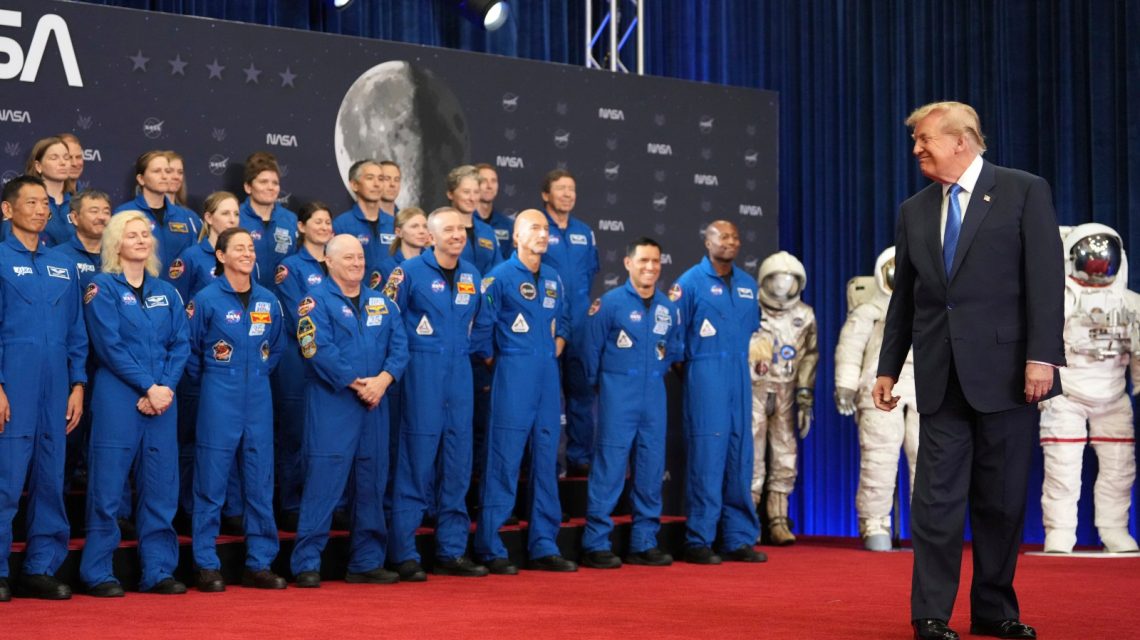
President Donald Trump has announced the establishment of a U.S. Space Academy to train future astronauts, engineers, and military personnel for Mars missions and more. During his visit to NASA’s Johnson Space Center in Houston, Trump emphasized the importance of equipping a new generation with the necessary skills to achieve ambitious space exploration objectives.
Trump stated that the academy will adhere to the high standards of reputable military institutions such as West Point and the U.S. Air Force Academy. ‘I said I’ll do it, but it’s got to be top line, it’s got to be the equivalent of the others,’ he remarked, indicating that a location for the academy would soon be chosen. Shortly after, Trump signed an executive order that formally established the new institution.
Michael Kratsios, assistant to the president and director of the White House Office of Science and Technology Policy, tweeted, ‘Today @POTUS signed an EO establishing the Presidential Commission on the United States Space Academy. The Commission, led by @NASAAdmin, will create a @NASA-led federal academy that combines rigorous technical education with leadership, discipline, and a commitment to public service. The mission is to prepare the next generation of astronauts, scientists, engineers, operators, entrepreneurs, civil servants, and warfighters. American space superiority will be won by the people we train to explore, secure, and build there.’
Potential Locations for the U.S. Space Academy
Trump has yet to designate the location for the proposed academy, leading to speculation about where it might be sited. Possible contenders include Houston, home to NASA’s Johnson Space Center; Colorado Springs, the base for U.S. Space Command; Cape Canaveral, a busy launch center; and Huntsville, a longstanding hub for NASA and aerospace activities.
The executive order gives a newly formed presidential commission 120 days to make recommendations about the academy’s structure, mission, and site-selection process. This suggests that detailed planning is still underway. The commission will also develop an implementation strategy, including timelines and any legislative actions needed to establish the academy. Further planning, funding, and potential congressional actions may be required before the academy can admit students on a permanent campus.
Differences from NASA Space Camp
The envisioned U.S. Space Academy would significantly differ from NASA’s Space Camp. Trump’s remarks highlighted that the academy would be a federally chartered institution modeled on military academies, focused on training service members, engineers, and civil operators for extended space missions and national space objectives.
Students at the Space Academy will undergo formal education and professional training aimed at careers in the space industry, a departure from the short-term educational offerings of NASA’s Space Camp. Space Camp offers public educational experiences, introducing participants to space science through simulations and hands-on learning, but it does not offer degrees, military commissions, or professional qualifications.
While Space Camp aims to foster interest in STEM fields and space exploration, the proposed Space Academy aligns more closely with the structure of a military service academy or a specialized university. If developed as President Trump has outlined, it would serve as a pipeline for future space professionals and government personnel, whereas Space Camp is primarily an outreach and educational initiative providing a taste of astronaut training.