Computer programmer Fei Zhaojun faced a surprising change in his work environment when his boss questioned the potential of artificial intelligence (AI) replacing human coders. Shortly afterward, Fei found himself laid off, along with around 160 colleagues from his Beijing job. This situation is becoming more frequent as AI’s integration into China’s job market accelerates, influenced by supportive government policies. Some economists express concern that these advancements could eventually weaken the global standing of the world’s second-largest economy.
AI adoption in various sectors, such as programming, writing, and physical labor, is increasingly leading to job displacement or fears of future job loss. China remains at the forefront of AI implementation, with policies promoting its usage across many aspects of life. Individuals like Fei are now seeking ways to adapt to these changes.
Shujing He, a senior analyst at Plenum, a Beijing-based advisory firm, notes a general acceptance or mild interest in AI across China, as opposed to negative sentiment seen elsewhere. Many who feel threatened by job replacement are keen to explore new opportunities through AI-enabled businesses and independent ventures. Fei had initially doubted AI’s ability to perform coding tasks perfectly. However, he conceded that mid-level coding roles are largely replaceable and has since focused on creating vlog-style videos about ordinary lives, which he hopes will resonate with others.
Adapting to AI Advancements
Du Qinchun, a part-time translator from Chengdu, is contributing to AI’s growth by assisting in training translation models, a role providing temporary employment. Nonetheless, the industry has seen significant pay reductions, contributing to shifting interests away from traditional language programs in colleges.
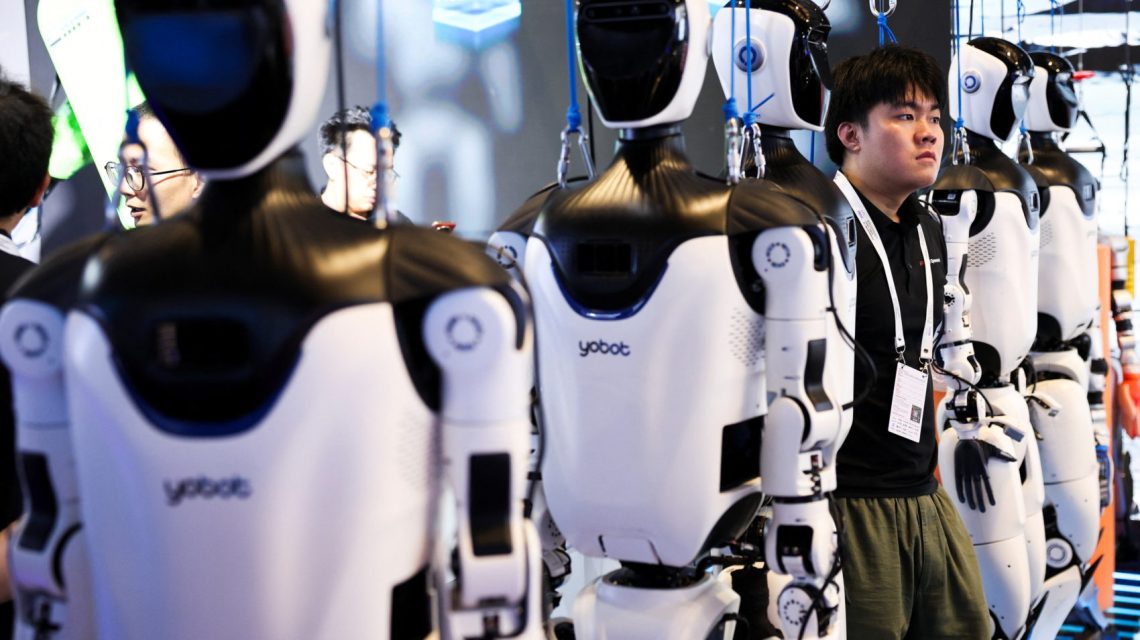
The proportion of Chinese industrial enterprises adopting AI models surged from 9.6% in 2024 to 47.5% last year, as stated by market intelligence firm IDC. This reflects the expansive use of AI innovations within industries, narrowing the gap between foundational capabilities and enterprise value creation. Humanoid robots are emerging in various functions, from sorting parcels and directing traffic to making coffee, impacting such fields as food delivery.
Generative AI finds growing applications in China’s short drama industry. It enables tasks previously requiring specialized training to be handled by anyone with access, notably in software development and multimedia creation. Plenum’s He highlights potential job displacement risks in these sectors.
The International Labor Organization underscores different impacts of AI across genders, identifying women as more susceptible due to their concentration in automatable areas, like electronics assembly, aggravated by underrepresentation in science and technology.
AI’s Mixed Impact on China’s Economy
Under China’s “AI Plus” initiative and five-year plan through 2030, the government aims to integrate AI throughout the economy to bolster its technological competitiveness against the U.S. Zilan Qian from Oxford China Policy Lab remarks that the government’s proactive diffusion of AI could expedite its penetration across various domains as compared to other countries.
China’s economic progression faces hurdles as consumer spending stalls amid job insecurity and housing market decline affecting household wealth. Despite technological innovations boosting productivity, the resultant job reductions could destabilize societal stability as described by Cornell University professor Eswar Prasad.
As in America, Chinese tech firms have significantly restructured or downsized roles, including those affected by AI integration. China’s urban unemployment rate stands at approximately 5%, while the 16-to-24 age group’s rate—excluding students—reaches thrice this figure. Some experts believe that long-term unemployment rates might decrease due to a rapidly aging and shrinking population, suggesting AI could offset workforce declines, as discussed by Xuenan Cao, a professor at San Francisco Bay University.
Innovative Paths through AI
Wang Zhicheng, formerly a scriptwriter at an educational media company, leveraged AI for brainstorming and fact-checking. Post-layoffs, Wang transitioned to creating illustrated books for children, despite AI-generated scripts seeming repetitive and formulaic. Viewing AI as a tool, Wang emphasizes human decision-making in honing AI outputs for creative endeavors.
High school teacher Yang Zheng acknowledges AI’s role in assisting students with homework—considering it a supplementary educational tool that is improving despite errors. He remarks, “It is beneficial for students,” allowing for real-time queries that teachers might not readily address.
Fu Ting from Washington and AP video producer Wu Jia from Beijing contributed to this narrative.
Supporting Independent Journalism
A free press is vital to a healthy democracy. We encourage supporting trusted journalism for maintaining civil dialogue.
 AI and the Changing Nature of Google Searches
  Data Centers Stir Controversy in Texas Amid Growth Boom
  The Technology Rivalry: Trump’s Meeting with Xi and the AI Ecosystem Clash
  Ways to Protect Your Finances from Cyber Threats
  Interview with Nvidia CEO Jensen Huang: AI Outlook and Business Strategy
  Concerns Rise Over Addictive Design of Sports Betting Apps