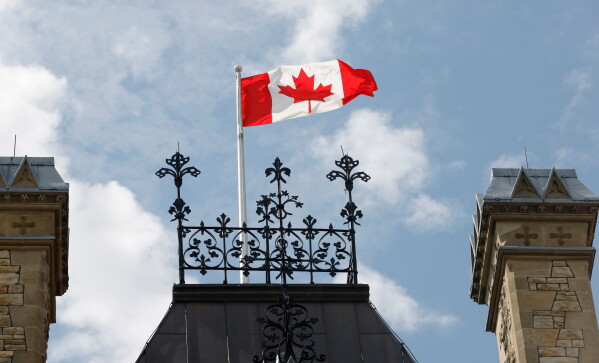
Mark Carney, Canada’s prime minister, has garnered international attention by urging middle powers to resist economic coercion from more dominant nations. This stance is being tested by President Donald Trump’s imposition of sweeping new tariffs, illustrating how resilient Canada can be against economic strain.
Late Friday, tensions escalated as Canada withdrew from negotiations, deciding the U.S. was requesting excessive concessions for tariff relief. The United States enforced a 50% duty on approximately $20 billion worth of Canadian products. Carney announced that Canada would retaliate, dollar-for-dollar, starting September 8. Carney’s statement, “We’re going to hit back,” signifies a refusal to yield to tariff pressures, unlike many American allies who have chosen to avoid such risk.
For Carney, this situation is the most definitive test of his belief that middle powers should stand firm against economic intimidation from great powers like the U.S. and China, even when it entails a cost. Canada’s response may illustrate how countries operate in a world where historical alliances offer less security and economic relations turn into leverage instruments. Additionally, the scenario could influence Carney’s domestic and international reputation and affect how other U.S. allies counter the Republican president’s policies.
The trade disagreement has become a sovereignty test, as Carney remarked that the U.S. had inserted language in the concluding negotiation phases restricting Canada’s ability to engage in trade deals with others. He deemed this demand “unacceptable” and considered it “a question of sovereignty.” British Columbia Premier David Eby stated accepting such terms would make Canada “the economic equivalent of the 51st state”—a notion Trump often speculates about.
Carney’s message gained traction in January at the World Economic Forum in Davos, Switzerland, where Europe was bracing for Trump’s Greenland threats and potential new tariffs. Carney remarked that the global order was experiencing “a rupture, not a transition,” arguing that sovereignty would increasingly rely on a nation’s capacity to “withstand pressure” and highlighted the vulnerability of middle powers negotiating alone with great powers. Trump rebutted by emphasizing Canada’s dependence on the U.S., remarking, “Canada lives because of the United States.” He has persistently hinted at making Canada the 51st U.S. state and dismissed the border as artificial.
In a Truth Social post, Trump accused Canada of imposing “massive amounts” of tariffs on U.S. farmers for years and asserted, “No more!” Seven months post-Davos, Canada has emerged as a test case for Carney’s theory. Carney accused Washington of wielding “economic integration as a weapon” and stated its “signature was written in pencil.” His stance confronts the question of whether Canada can show resilience to pressure.
Historian Robert Bothwell noted Canada’s unique vulnerability to American pressure, asserting no country is more exposed than Canada. Nearly three-quarters of Canadian exports target the United States, which has an economy size tenfold Canada’s economy. Although Canada could secure new trade agreements, replacing customer and supply chains accumulated over decades surrounding the U.S. market poses considerable challenges.
Carney admitted retaliation would “raise costs and reduce choice for Canadians.” Meanwhile, U.S. Trade Representative Jamieson Greer refuted Canada’s negotiation breakdown account, accusing Ottawa of introducing new demands and retracting commitments after Washington’s offer to decrease tariffs on steel, autos, lumber, and other goods. He mentioned the U.S. would proceed with additional actions due to Canada’s retaliation, hinting at heightened tensions.
Nelson Wiseman, University of Toronto political science professor emeritus, considered Canada the most significant test of Carney’s strategy and investigated whether resistance by a single middle power could instigate broader changes. Ian Bremmer, Eurasia Group president, remarked Americans often underestimate Canadians’ anger towards Trump, noting the current hard stance against U.S. policy perceived as predatory, despite substantial economic repercussions, enjoys popularity among Canadians.
Recently, this sentiment surfaced in sports, as fans in Vancouver and Montreal booed the U.S. national anthem before Major League Soccer matches, echoing similar responses during last year’s trade war. Manitoba Premier Wab Kinew recommended Canadians brace for a prolonged confrontation, predicting potential weakening in Trump’s position after the U.S. midterm elections in November.
Carney has framed the situation as a test of whether Canada can maintain its independence under U.S. pressure. “Last spring, I warned that America is trying to break us so that they can own us,” Carney declared. “And I promised, ‘That will never, ever happen.’ We are keeping that promise.”
 Ken Paxton’s Campaign Funding and Polls
  Inside the Secret Deals Powering the President’s Push to Deport Migrants to Countries Not Their Own
  Independence of Research from Political Agendas
  Sen. Roger Marshall Denies Allegations of Political Attack
  Concerns About Food Safety Reach Critical Levels
  Court Blocks Trump’s Mail-Ballot Rules Ahead of Elections