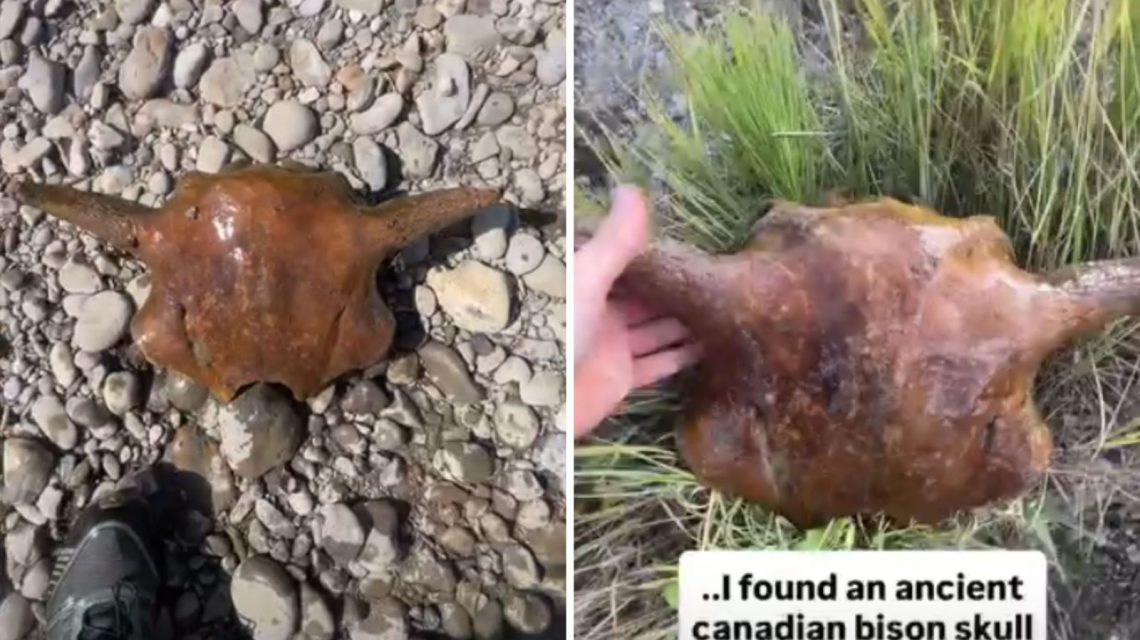
An Alberta fisherman made an intriguing find while fishing in the province. Dominic Boon, a local resident near Banff, discovered something unusual protruding from a creek. His curiosity peaked, he decided to retrieve it and soon realized it might be significant.
Unexpected Discovery
Boon’s outdoor adventures regularly include searching for unique objects. However, this discovery during a fly fishing outing stood out. Accompanied by two friends, Boon initially heard their guess that it resembled a cow skull. Yet, the presence of horns suggested otherwise to him.
Increased Rainfall Uncovers Skull
Boon’s suspicion was confirmed the next day when the object got identified as a bison skull. Recent heavy rains, part of Alberta’s record-breaking wet summer, likely unearthed the skull, which may have been buried for years. Boon explained, “During June, [there was] unprecedented rainfall, and it washed all the banks and washed all fresh stuff down the creek.”
Weighing a couple of kilograms, the skull’s weight suggested a significant possibility of ancient origins. Boon speculated it might be much older than recent animal remains.
Possibly a 5,000-Year-Old Artifact
Eager to uncover its age, Boon reached out to experts. Dr. Chris Jass from the Royal Alberta Museum confirmed it as a bison skull. He estimated its age could range up to 5,000 years, though the exact timeframe remained uncertain.
The estimation came from characteristics like its shape and eye sockets. Boon considered it might date as recently as 150 years old, at the youngest.
The U.S. National Park Service notes that quick burial aids in preserving animal remains, shielding them from environmental factors. This preservation might explain the skull’s condition over the centuries.
Further Analysis Planned
Boon intends to present the skull to the museum for further study. Experts there may employ various techniques such as measuring, weighing, and scanning to gain insights about the artifact.
“It’s just crazy,” Boon commented about the unlikely find.
Significance of the Discovery
The skull’s significance also ties to the historical context of bison in Alberta. Once abundant, both plains and wood bison faced near extinction in the late 1800s due to habitat loss and other factors.
Today, Alberta’s free-ranging wild wood bison number approximately 2,800, while plains bison occupy a fraction of their former territory. This backdrop adds notable interest to the skull, regardless of its age.
 Historical Discrepancies and Diplomatic Sensitivities in U.S.-China Relations
  Escalating Tensions: Russia’s Nuclear Threat and the Kaliningrad Conundrum
  Marco Rubio Discusses Thwarted UK Terror Plot and Global Threats
  New Leads Emerge in 2014 Ayotzinapa Student Disappearance Case
  Concerns Over U.N. Secretary-General Candidate’s Alignment
  Possible Shipwreck Exposed After Nor’easter in Nantucket