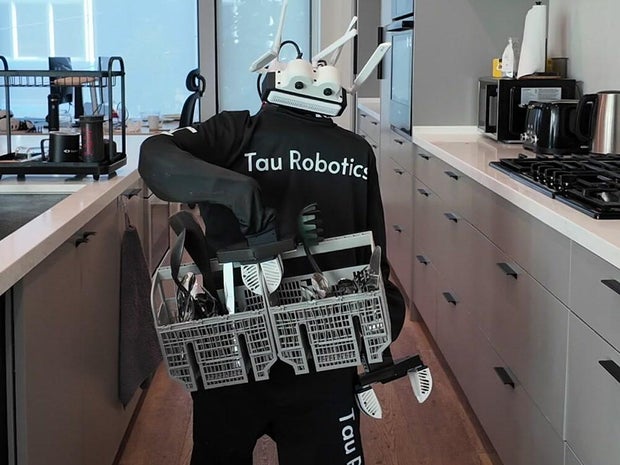
By August 11, 2026, CBS News reported on an innovative service launched by Tau Robotics, an engineering company based in San Francisco. This company now offers some residents the option to hire humanoid robots for household cleaning at a rate of $30 per hour. This initiative is part of a pilot program available to 1,000 households.
The humanoid robots, which cost $50,000 each to produce, perform tasks such as vacuuming, cleaning kitchen surfaces, and trash removal. The robots wear Tau Robotics uniforms and have names like Chelsea and Elon. The company employs artificial intelligence to train these robots. “Initially, they replicate human performance and later aim to surpass it,” said Alexander Koch, Tau’s co-founder and CEO.
Currently, the service operates on an invite-only basis. Tau plans to increase the number of cleanings to 1,000 per week in San Francisco by 2027, with aspirations to expand across the U.S. and internationally by 2028. Other companies, like IX Technologies with their robot Neo, are also exploring similar technologies. However, experts estimate it could take five to ten years before these robots perform household tasks effectively and reliably.
Operational Challenges and Human Supervision
Due to the current limitations, human technicians remotely operate these robots. They supervise the AI and are ready to intervene if a robot struggles with a task. Technicians use VR goggles to view through the robot’s cameras. According to Koch, the robots still require substantial human direction and lack capabilities like climbing stairs or autonomously identifying cleaning areas.
Safety and Security Concerns
Ken Goldberg, an engineering professor from the University of California, Berkeley, pointed out the challenges in developing humanoid robots. While they might appear nimble, their weight makes them prone to falling, which could be dangerous if they accidentally hit someone while getting up. Goldberg also cautioned against keeping robots near children due to the risk of unintended movements.
Koch mentioned that Tau’s technicians monitor safety, ready to activate a safety mode if necessary, which prompts the robot to lay down to prevent accidents. The company aims to gradually phase out these technicians by 2028 or 2029 as robots become more autonomous.
Aside from safety, privacy is another concern. The robots, equipped with cameras, capture video footage used for AI training and technology improvement. These cameras might inadvertently record personal information in people’s homes. Koch assured that Tau manages all data securely, maintaining full control over its systems.
The Future of Humanoid Robots
The humanoid robot industry is poised for significant growth. Barclays Investment Bank estimates the market could expand from its current valuation of $2-3 billion to $200 billion by 2035. According to Morgan Stanley Research, the humanoid robot population could reach nearly 1 billion by 2050, though they note that prices must drop and societal acceptance of robots increase for widespread domestic adoption.
Currently, humanoid robots primarily function in industrial settings like manufacturing and warehousing. As their capabilities improve, analysts expect increased interest in home applications. Zornitsa Todorova of Barclays predicts a gradual adoption and believes economic opportunities for service-oriented humanoids are promising.
Yet, Goldberg remains skeptical of rapid advancement in this field. He suggested that a decade might pass before humanoid robots effectively handle household services like cleaning. “We are not close to having humanoid butlers,” he remarked.
 Attorney General Blanche Opposes New AI Regulations
  Parallels Between ‘Threads’ and AI Fears
  AI as a Modern Charismatic Entity
  Concerns Rise Over AI Agents Targeting Websites for Information
  FAA Investigates Software Glitch in Boeing 737 Max Jets
  Protecting Your Finances from Cyber Threats