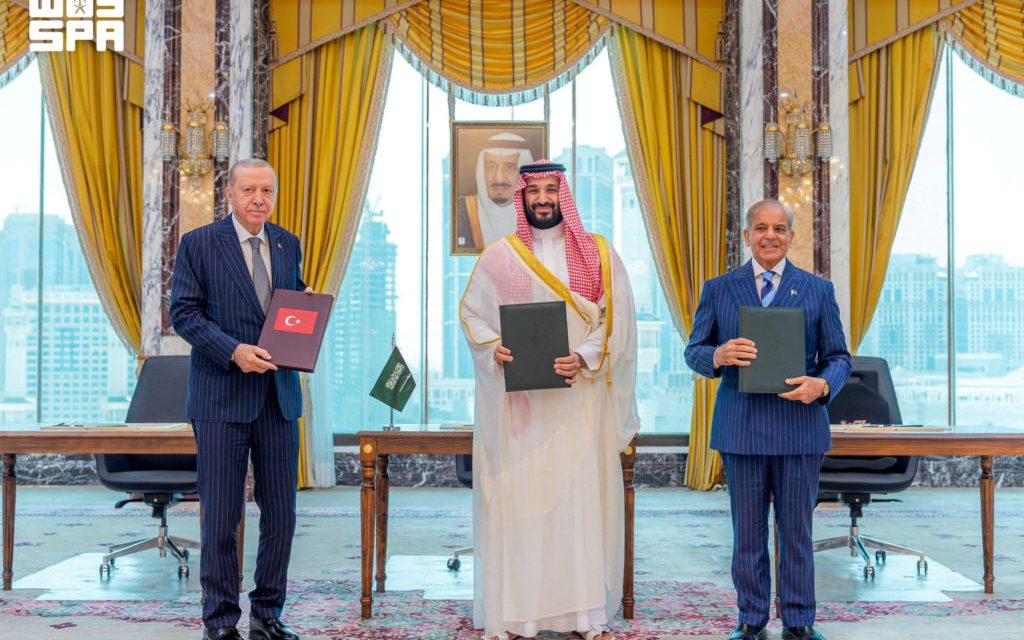
Pakistan’s foreign minister clarified that a new defense pact signed with Saudi Arabia and Turkey is not targeting any specific nation. The Makkah Joint Defense Agreement, finalized on Friday, involves collaboration between Saudi Crown Prince Mohammed bin Salman, Turkish President Recep Tayyip Erdogan, and Pakistani Prime Minister Shehbaz Sharif. It aims to enhance security cooperation in light of rising tensions between the United States and Iran.
Pakistan’s Foreign Minister Ishaq Dar stated on Sunday that the agreement is strictly defensive and available for other regional nations to join if they agree to its principles and peaceful conflict resolution. His comments mirrored Turkish Foreign Minister Hakan Fidan’s statement that the deal is not against Iran or any other country.
The agreement ensures that an armed attack on any member state is considered an attack on all, based on statements from all three countries. Dar emphasized that this aligns with the right to self-defense under Article 51 of the U.N. Charter. Pakistan remains committed to fostering lasting peace and stability in the region.
Dar also mentioned that the Makkah Accord does not override existing bilateral or multilateral agreements. The deal was celebrated publicly with landmarks in Islamabad and Saudi cities lit in the colors of their national flags.
The three countries bring unique strengths to the agreement. Pakistan offers significant military experience as the Muslim world’s only nuclear-armed nation. Saudi Arabia provides economic resources and regional influence, while Turkey contributes a large military and an advanced defense industry.
Defense experts in Islamabad advise against viewing this deal as equivalent to NATO, despite its collective-defense aspect. Abdullah Khan, a defense analyst, noted that although the agreement came amid regional tensions, it is not directed at Iran or any other country specifically. Pakistan and Saudi Arabia have a long-standing mutual-defense relationship, and Pakistan-Turkey defense cooperation has increased in recent years.
Images of the leaders, including Pakistani Prime Minister Shehbaz Sharif and Saudi Crown Prince Mohammed bin Salman, were displayed prominently on billboards following the agreement.
 Google Fined for Breaching EU Privacy Rules
  South China Sea Tensions Rise after Collision between Chinese and Philippine Ships
 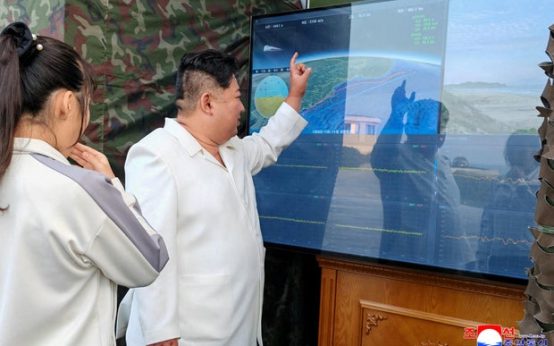 North Korea’s Hypersonic Weapon Test Amid Global Tensions
  Austin Tice: A Search for Answers
 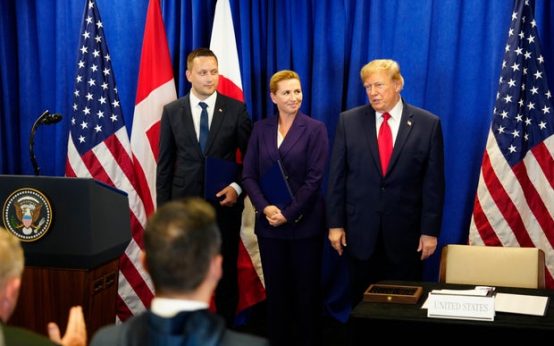 U.S., Denmark, and Greenland Forge New Security Agreement
 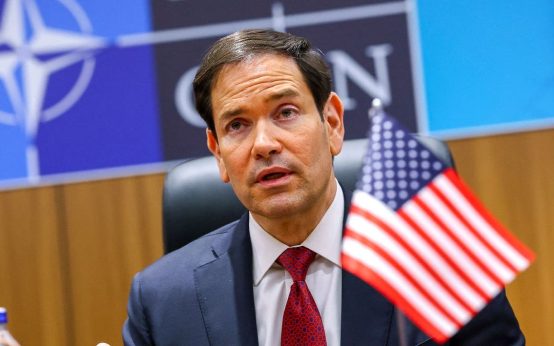 Secretary Rubio Discusses Middle East Conflict and NATO Relations