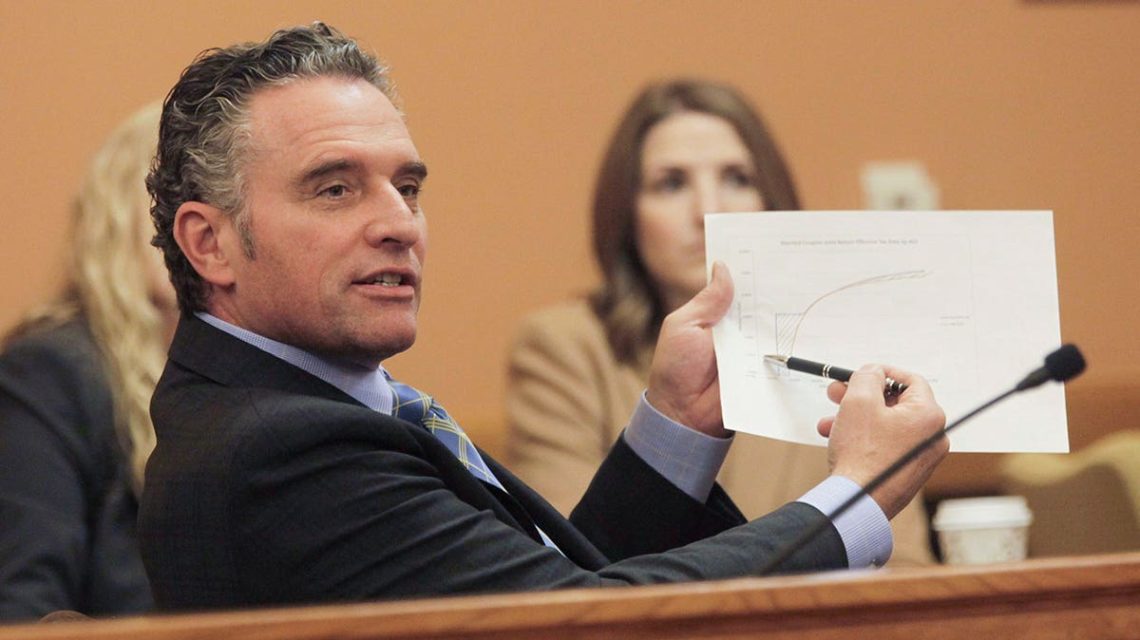
Democrats are aiming to keep the governor’s seat in Kansas, a traditionally strong Republican state, through their candidate Cindy Holscher. She will face Republican nominee Ty Masterson in the general election on November 3.
Current Democratic Governor Laura Kelly is term-limited. The Democratic Party is strategically working to maintain its hold on the governor’s office. The GOP, however, views this open-seat race as a significant chance to regain the governorship, after Kelly’s two-term leadership.
The Democratic candidates included state Senators Ethan Corson and Cindy Holscher, along with Overland Park Mayor Curt Skoog.
Kansas Senate President Ty Masterson, a Republican candidate for governor, seeks to follow term-limited Democratic Gov. Laura Kelly. (AP Photo/John Hanna)
On the Republican side, a diverse group of candidates vied for the nomination. These included Secretary of State Scott Schwab, Senate President Ty Masterson, Insurance Commissioner Vicki Schmidt, former Johnson County Commissioner Charlotte O’Hara, businessman Nick Reinecker, businessman Philip Sarnecki, and former Johnson County Sheriff Stacy Rogers.
The primary election in Kansas coincided with a key constitutional amendment proposal. This proposal aims to replace the current system of appointing Kansas Supreme Court justices by holding direct elections instead. Backed by Republican lawmakers, it seeks to revise the judicial selection process following criticism from conservatives. If enacted, it would amend the Kansas Constitution to elect Supreme Court justices rather than appoint them through the state’s nominating commission system.
The winner of November’s election will determine who governs in Kansas as Republicans push for unified control of state government. (Don and Melinda Crawford/UCG/Universal Images Group/Getty Images)
The upcoming governorship will see a change as Laura Kelly reaches her term limit in January. Kansas has seen frequent changes in leadership in recent cycles. Despite its traditionally Republican lean, with 57 percent voting for President Donald Trump in 2024, leadership has alternated between Democratic and Republican hands.
Amanda Macias analyzes the connections between business, economics, and politics, particularly focusing on policy impacts on markets, businesses, and American workers.
 The War on Poverty: A Lesson on Intentions and Outcomes
  Reporters Blocked from White House by Trump Administration
  Universities Should Reject Political Influence on Research Funding
  Trump’s Approach to China: Trade Dynamics and Challenges
  Media Outlets Sue After White House Ban
  American Public Opinion on Press Freedom