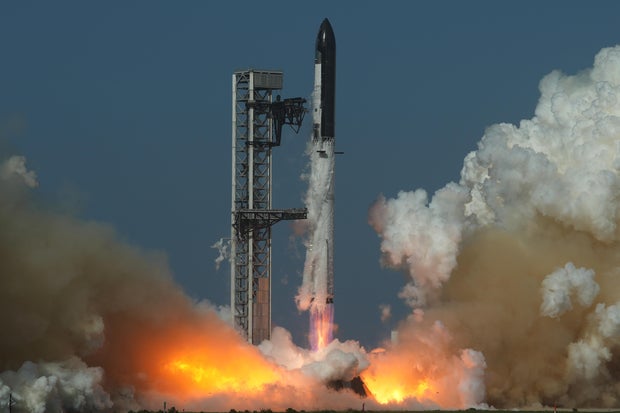
SpaceX recently marked its thirteenth launch of the Super Heavy-Starship rocket, showcasing an ambitious yet challenging venture into space exploration. The massive booster made an on-target splashdown off the Texas Gulf Coast, while the Starship upper stage successfully embarked on a sub-orbital hop to the Indian Ocean.
The launch took place from SpaceX’s Texas-based “Starbase,” with a towering 397-foot-tall rocket powered by 33 methane-fueled Raptor engines. The rocket launched at 5:51 p.m. EDT, producing a dramatic show of power with 16 million pounds of thrust as it ascended into the sky.
A prior attempt on July 16 was thwarted by a last-second abort due to engine issues, which were subsequently resolved before the latest launch. However, inclement weather delayed the flight by 24 hours. On launch day, all engines performed normally, and the rocket took off under a mostly clear sky.
This mission was the second test flight of a third-generation Super Heavy-Starship. The initial flight in May revealed several issues, with the booster missing its landing target and the Starship encountering early engine failure. This time, the booster performed as expected, managing its ascent and detachment from the upper stage.
Nevertheless, fewer engines restarted than planned during its descent, resulting in a “hard” splashdown at a higher-than-anticipated velocity. The booster is engineered to return to the launch site, where mechanical arms, named “chopsticks,” catch it mid-air. For safety, SpaceX opted for splashdowns in initial flights.
Meanwhile, the Starship upper stage continued its climb, deploying 20 third-generation Starlink satellites as a part of a real-world test of a new payload dispenser. Furthermore, six satellites were equipped with cameras to evaluate the Starship’s heat shield tiles and overall condition, aiding engineers in future assessments before re-entry.
A vital test involved the brief re-ignition of one Raptor engine to prove it can restart in space—essential for upcoming lunar missions. The spacecraft then executed a belly-first re-entry before flipping upright for a gentle splashdown in the Indian Ocean one hour and five minutes after launch. SpaceX expects the Starlink satellites to burn up upon re-entering the atmosphere.
This successful flight was welcome news to NASA, relying on the Starship upper stage as a lunar lander for the Artemis program. Notably, the Starship remained intact after splashdown, offering invaluable insights for future missions.
In preparation for moon missions, SpaceX plans to launch up to 15 tankers to refuel the lander in orbit before heading to the moon. However, the lunar lander variant has yet to fly, and no Starship has achieved Earth orbit. Criticism has been voiced about the complexity and feasibility of this ambitious flight schedule.
The Government Accountability Office (GAO) identified SpaceX’s propellant transfer technology as a program risk. It requires on-orbit fuel transfer between Starships before docking with the Orion spacecraft in lunar orbit. Furthermore, SpaceX’s progress in updating its Raptor engines is behind schedule, affecting key events like critical design review and propellant transfer demonstrations.
NASA managers are exploring alternatives, including collaboration with Blue Origin, which is developing its lunar lander. Blue Origin recently faced setbacks when their New Glenn rocket exploded during a test. Nevertheless, the company aspires to resume test flights by the year’s end.
NASA is moving forward with an interim Artemis flight planned for next year. The mission involves launching four astronauts in an Orion capsule to test key procedures for lunar landing missions. They will dock with a Blue Origin lander and a modified Starship model during this test flight.
These developments mark significant strides in space exploration, but substantial challenges remain as SpaceX and its partners work toward ensuring the success of the Artemis program.
 NASA’s Challenges Amid Goddard Space Flight Center Relocations
  Lost City Linked to Jesus Discovered Near the Sea of Galilee
  NASA’s Launch of the Nancy Grace Roman Space Telescope
  NASA Launches Nancy Grace Roman Space Telescope to Explore Universe’s Mysteries
  Trump Engages with Astronauts and Honors Artemis II Crew
  NASA’s Nancy Grace Roman Telescope Prepares for Launch