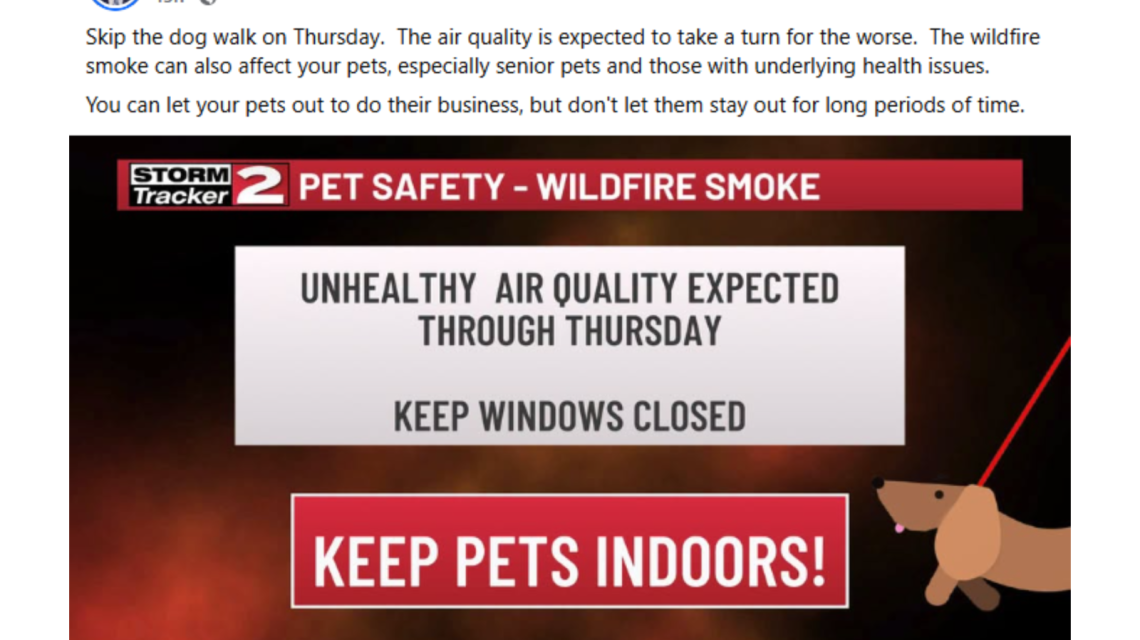
Residents in New York State are advised to stay indoors and reduce outdoor activities due to a combination of extreme heat and smoke from Canadian wildfires affecting air quality. The situation has led to hazardous pollution levels across the state.
Current Conditions
An Air Quality Health Advisory is in place in New York. Smoke from Canadian wildfires has covered parts of the state, increasing concentrations of PM2.5, a fine particulate matter. The National Weather Service (NWS) warns that heat wave conditions coincide with this smoke. Temperatures in parts of New York City are nearing 100 degrees Fahrenheit, with heat index values surpassing 100.
The New York State Department of Environmental Conservation and Department of Health have extended air quality advisories throughout the state. The most affected areas include Western New York, Central New York, and the Eastern Lake Ontario region. Air quality in regions like New York City, Long Island, and the Lower Hudson Valley is considered ‘unhealthy for sensitive groups,’ with some upstate areas classified as ‘unhealthy.’
Health Risks
Health officials warn that smoke pollution can cause coughing, dizziness, fatigue, and breathing problems. It may also worsen conditions like asthma and heart disease. Residents are advised to limit outdoor activities, keep windows and doors closed, use air conditioning or purifiers, and wear N95 or KN95 masks outside.
Meteorologists caution that even routine activities like walking a pet can increase exposure to smoke in bad air quality periods. Forecasts predict that New York City’s Air Quality Index (AQI) may reach 200, which is unhealthy for everyone.
City’s Response
New York City has initiated emergency measures. The city’s heat emergency plan is extended, with numerous cooling centers available across all boroughs. Residents can find cooling centers via an online tool or by calling 311.
Free KN95 masks are provided to residents to protect against smoke. These are available at Brooklyn and Queens libraries, selected libraries in other boroughs, and subway, Long Island Rail Road, and Metro-North stations.
Ongoing Measures and Advice
Mayor Zohran Mamdani outlined steps to aid vulnerable populations, including increased outreach efforts. Activities at schools, parks, and other locations have been shifted indoors or rescheduled. The city advises staying in air-conditioned places, staying hydrated, and checking on vulnerable residents, especially the elderly.
New Yorkers are encouraged to subscribe to Notify NYC for emergency alerts and stay informed about air quality forecasts. City and state officials stress that the combination of heat and smoke represents a significant health risk. Residents should follow advice to minimize exposure and ensure safety during this period.
 Growing Concerns Over Food Safety and National Security
  Teen Arrested in Penn State Student’s Murder; Second Suspect at Large
  Carnival Panorama Passenger Jumped Overboard During Final Leg of Cruise
  Nikole Hannah-Jones Reflects on Educational Choices for Her Daughter
  Life and Challenges at Chennai’s Kasimedu Fishing Harbour
  Chicago Bears Eye Potential Move to Indiana: A Look at the Developments