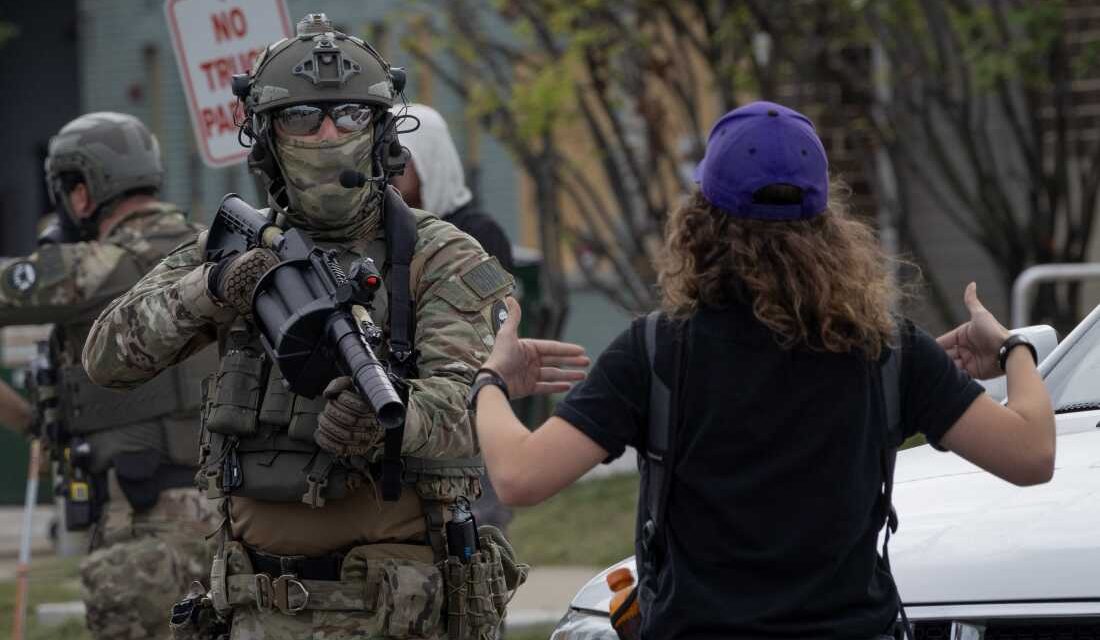
Federal law enforcement officials confronted demonstrators outside an immigration processing center in Broadview, Illinois, on September 19, 2025. The protests targeted a surge in ICE activities within the Chicago area, part of the Trump administration’s intensified campaign against undocumented immigrants known as Operation Midway Blitz.
Following two recent fatalities involving Immigration and Customs Enforcement (ICE) officers, the American Civil Liberties Union (ACLU) published a report highlighting the agency’s widespread use of force. Released Thursday, the report reviews over 1,200 ICE operations in eight states from January 2025, when President Trump resumed office, up to the end of the previous year.
ACLU findings highlight the recurrent use of force in immigration enforcement, supporting long-standing concerns from immigrant advocacy groups about the violent nature of ICE actions. Approximately one-third of the investigated incidents involved direct use or threat of violence.
“The default tool for immigration enforcement agents has become the threat or actual use of force,” stated Naureen Shah, ACLU director of policy and government affairs for immigration.
The report’s analysis covered incidents reported by news outlets, community groups, and institutions like schools and hospitals. It documented who participated in the enforcement, how actions unfolded, and their locations.
University of South Carolina law professor Seth Stoughton expressed concern over the ACLU succeeding in documenting matters he believes should be transparent from the Department of Homeland Security (DHS). “Democratic governance demands public assessment to determine effectiveness, underpinned by transparency,” he noted.
Methods of Force Used by ICE Officers
The ACLU report details varied tactics ICE officers employed, from pushing, tackling, and pinning individuals to the ground, logged over 400 times, to deploying weapons such as chemical irritants, rubber bullets, and tasers. Researchers also recorded officers using potentially deadly maneuvers, like applying knee pressure on necks and chokeholds, restricted by many local police authorities.
Despite requests for comment, ICE and DHS did not respond regarding the report’s findings. The data revealed frequent enforcement occurrences in ordinary settings including bus stops, grocery stores, and roadside encounters. Numerous incidents involved children, US citizens, protesters, bystanders, and journalists. Although comprehensive, the report reflects a fraction of the enforcement spectrum and focuses on operations clearly identified at the federal level.
Since Trump re-assumed office, ICE’s enforcement activities have intensified, backed by increased federal funding, thereby heightening potential for violent interactions.
“There’s a culture of abuse and impunity driven by excessive pressure to achieve arrest quotas,” Shah commented. “When combined with funding, the risk of escalating violence multiplies dramatically.”
Traffic Stops and Enforcement Strategies
ICE’s new enforcement approach incorporates widespread traffic stops, diverging from its previous, targeted operations, explains Jillian Snider, retired NYC police officer and John Jay College lecturer. “Previously, ICE operated with targeted objectives, identifying specific locations for wanted individuals,” Snider described. Recent shifts result in more indiscriminate stops lacking comprehensive training.
Recent fatal shooting incidents involved ICE officers killing men during car stops in Texas and Maine, despite neither being targets of planned ICE operations. DHS claims Durán Guerrero fled, prompting an officer to shoot “fearing for public safety,” while witnesses disputed the account regarding Salgado Araujo.
Neither incident involved officers using body cameras.
ICE encounters often include aggressive tactics like vehicle ramming, boxing-in, and window smashing as highlighted by the ACLU’s report. These methods raise supervision and training concerns, according to Stoughton. “Persistent mistakes regarding traffic stops suggest both training inadequacies and supervisory shortcomings,” he remarked.
This week, another deadly incident took place in Florida, where a third person died while fleeing ICE during a truck encounter. Experts emphasize the complexity ICE officers face during vehicle stops, required to consider variables like vehicle position, doors’ status, and passenger presence.
Marc Brown, heading the University of South Carolina’s Excellence in Policing, acknowledged the limited scope of defensive training ICE officers received during his tenure at the Federal Law Enforcement Training Center. “Policy and training adjustments are critical when altering mission objectives,” argues Brown.
Following the Texas and Maine fatalities, ICE intends to pause non-critical traffic stops. However, details on implementing this decision remain uncertain. While ICE refrained from discussing enforcement tactics, it affirmed ongoing evaluations of procedures for officer safety.
Nonetheless, President Trump voiced support for the continuation of ICE traffic stops in a Truth Social post.