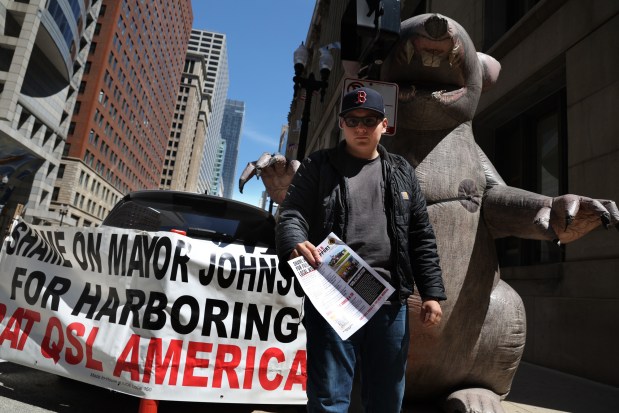
At the entrance of the Calumet River on Chicago’s industrial Southeast Side, workers engage in loading and unloading steel, sugar, and lumber from ships. This port serves as the hub of Chicago’s maritime economy. Currently, however, labor disputes are extending past the docks and into City Hall, affecting Chicago Mayor Brandon Johnson—himself a former labor organizer—and his potential re-election campaign occurring in less than a year.
Two unions are contending over representation of stevedores employed by QSL America, a private company functioning at the publicly owned port. For over a year, some QSL workers have been striking, organized by the International Union of Operating Engineers Local 150. Yet other workers continue to be employed, operating under a new collective bargaining agreement with the International Longshoremen’s Association (ILA).
QSL opted to recognize the ILA as the workers’ union representative last year, following the commencement of the Operating Engineers’ strike, leading to an ongoing conflict between the unions, now under examination by federal regulators at the National Labor Relations Board (NLRB). In June, Mayor Johnson met with ILA-supportive workers and appeared in a photograph with them, prompting accusations of hypocrisy from Local 150, which viewed the ILA-affiliated workers as strikebreakers.
Local 150’s president is connected with political committees that financially backed Illinois Secretary of State Alexi Giannoulias, seen as a prospective contender for the 2027 mayoral race. “Mayor Johnson crafted his public image using the language of solidarity and worker justice,” Kristine Kavanagh, Local 150 spokesperson, stated, “but during Chicago’s port workers’ time of need, he chose to meet with and smile in a photo alongside longshoremen and workers crossing the picket line.”
The ILA refutes the label of strikebreakers, claiming their supporters are long-established port workers who selected them for representation. Local 150 has displayed an inflatable Scabby the Rat outside City Hall for months in protest. As of June 22, 2026, Braulio Partida, striking alongside the International Union of Operating Engineers Local 150, distributed leaflets by Scabby the Rat.
Johnson issued a statement asserting ILA workers who met with him were part of the team negotiating their freshly ratified contract. “Over the past year, these workers organized their colleagues, successfully formed a union, and negotiated a contract ensuring higher wages alongside improved health and safety safeguards for every worker at the site,” spokesperson Griffin Krueger relayed, emphasizing Johnson’s commitment to support all working individuals.
Despite ongoing communications with Local 150 about the situation, the administration continues efforts to engage all parties involved. Around fifteen miles southeast, striking dockworkers begin picketing around 5 a.m. daily, holding worn signs. Operating Engineers Local 150 assert QSL struck an under-the-table deal to recognize the ILA to expel Local 150, though the ILA and the company maintain the majority of dockworkers chose the ILA for representation.
The Longshoremen assert they aided workers in negotiating a contract with hourly wage increases between $10-$15, enhanced health insurance, and improved safety protocols. Rusty White, president of a Portage-based ILA local and vice-president of the international union’s Great Lakes District Council, remarked, “We’re ironing out details at the table rather than erecting a picket line.”
The Chicago Federation of Labor stands with the strikers. They stated, “Workers deserve organizing rights free from employer interference, intimidation, or secretive arrangements — elected officials should support workers fighting for such rights.” Regulators reportedly found merit in two charges filed by Local 150 against the company and ILA, involving claims of unlawful assistance, though no official complaints have yet been issued.
NLRB spokesperson Sylvester Giustino declined comment on the pending case, nor confirmed any merit findings by Local 150. The ILA remains confident in prevailing in labor board proceedings, and QSL refutes charges filed against them by Local 150.
In the political sphere, Operating Engineers committees expended approximately $2.5 million supporting Giannoulias’ undeclared candidacy for Mayor. The ongoing dispute sheds light on the extensive political spectrum within Chicago’s labor movement. While Johnson’s roots are in the progressive Chicago Teachers Union, the Engineers’ historically leans right. This division may prove crucial as candidates vie for mayoral office in 2027, seeking financial backing.
Kavanagh of Local 150 insists the dispute centers on striking workers, not politics. The union battle presents legal intricacies, with safety emerging as a primary concern for Operating Engineers amidst the strike. Picketers shared stories of inadequate equipment and negligible training for newcomers.
QSL’s spokesperson Marie Deschamps claimed the company prioritizes health and safety, investigating employee concerns as required. Former worker Leo Lopez revealed he left due to unsafe conditions, noting deficiencies like absent machine horns and brakes. Safety concerns were exacerbated by mixing rainwater and stored sugar, creating hazardous conditions.
Striker Alex Muñoz, who worked at the port for 15 years, emphasized the urgency of maintaining workplace safety. Issues involving OSHA led to a settlement with fines nearing $53,000 for safety violations. Deschamps stated OSHA closed its investigation following improvements.
In contrast, ILA representatives claim their new contract established safety measures, including committees conducting semiannual safety audits. Andre Christian, having worked at NASCO for two decades, spoke positively of the collaborative efforts between QSL and ILA.
Marvin Sanders, employed at NASCO since 2017, expressed gratitude for the ILA’s role in enhancing worker protections in wages and healthcare. Sanders criticized Local 150 for neglecting communication with certain workers, noting, “The Operating Engineers never approached us.”
Local 150 reports 28 workers are striking, while ILA attorney Daniel Wolff cites approximately 35 active employees bound by the ILA’s contract. Numbers continue to fluctuate. The NLRB oversees union elections, requiring support from at least 30% of workers in a proposed bargaining unit to trigger a vote, ultimately certifying unionization given a majority vote.
QSL employees never participated in a union election. Deschamps asserted a neutral third party verified most employees preferred the ILA. Expressing support for employee representation rights, she stated QSL respects the freedom of association.
Bob Bruno from the University of Illinois noted QSL’s actions reflect top-down labor agreements. Lopez emphasized workers should independently choose union representation. The ILA argued its neutrality concerning employer deference.
Operating Engineers’ alleged interest in organizing port workers after crane operations disagreements was refuted. The Illinois International Port District attempts to remain neutral, though Local 150 demands QSL’s lease termination. Executive director Erik Varela expressed commitment to dialogue and worker’s rights.
Overall, the workers loading cargo where lake meets river face an ambiguous future. Federal data shows union membership at less than 6% within the private sector. Given this context, Bruno criticized the port worker conflict as wasteful for the labor movement.