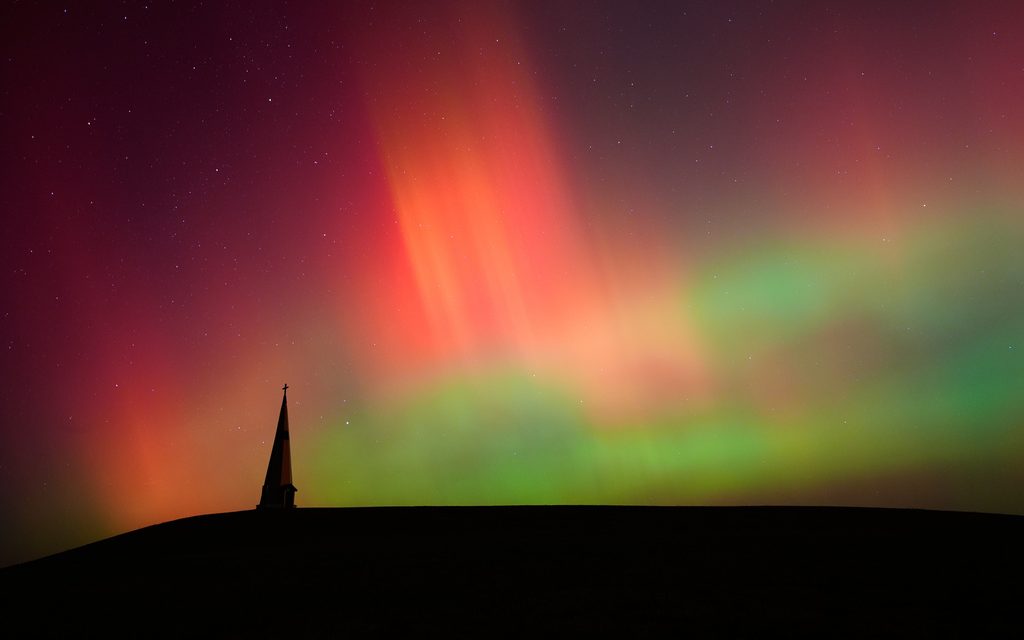
Over the July 4 weekend, nature might provide its own colorful display. According to the Space Weather Prediction Center (SWPC), some people may see the northern lights on Friday night.
Two significant sunspot groups have been monitored this week. A solar flare, reaching a strength of X1, was reported by Shawn Dahl, a service coordinator with the SWPC. In the classification system, ‘X’ is the highest classification for solar flares, though ‘1’ represents the weakest level in that tier. Dahl described the event as ‘impulsive’, suggesting it was brief but powerful.
The SWPC later confirmed that the associated coronal mass ejection (CME) might impact Earth, leading to ‘increased geomagnetic activity’. If the embedded magnetic field aligns correctly, moderate geomagnetic storm conditions could occur, offering a chance to witness the northern lights as Independence Day approaches.
Who Might See the Northern Lights on July 3?
If conditions match predictions, those in the northern U.S. could view the aurora. Moderate geomagnetic storms, classified as G2, might allow the lights to be seen as far south as New York and Idaho. This potential viewing area includes parts or all of Washington, Oregon, Idaho, Montana, North Dakota, South Dakota, Minnesota, Wisconsin, Michigan, Vermont, New Hampshire, New York, and Maine. Residents of Alaska also have odds of seeing the lights, as the state frequently has slight chances due to its location.
The University of Alaska Fairbanks suggests people living a bit further south—like Wyoming, Nebraska, Iowa, Illinois, Indiana, Ohio, Pennsylvania, and Massachusetts—might spot the aurora on the northern horizon.
Visibility relies heavily on timing. Should the geomagnetic storm peak before sunset, natural light could overpower the display. The SWPC anticipates that conditions could begin to strengthen around 2 a.m. EDT, persisting through the day. By sunset, activity may still be intense enough to light up the sky for some time.
There remains the chance that necessary conditions for the aurora do not entirely develop. You can access current forecasts on the SWPC’s website.
If the northern lights do appear, enhance your viewing prospects by focusing on the northern horizon. For better visibility, use your phone as newer digital cameras detect light better than the human eye, capturing the green, pink, and red hues more effectively.
 The Unique Challenges of the Pumpkin Toadlet
  Animal Self-Medication Insights
  Carlo Rovelli’s Perspective on Physics and Ultimate Reality
  Department of Defense Legal Waiver Promotes UAP Disclosure
  Ancient Ring Offers New Insight on Pontius Pilate’s Authority
  Lost City Linked to Jesus Discovered Near the Sea of Galilee