Fox News anchor Shannon Bream discusses the escalating conflict in the Middle East with reports from Trey Yingst in Tel Aviv. The United States recently targeted Iranian missile and drone storage facilities following Iran’s actions against shipping in the Strait of Hormuz. Iran responded by launching drones toward Kuwait and Bahrain, while Israel conducted its own military strikes against Hezbollah in Lebanon. These movements occur amid a diplomatic agreement between Israel and Lebanon.
Chaos in the Strait of Hormuz
A new period of increased risk and uncertainty is affecting the Strait of Hormuz, warns shipping firm Hapag-Lloyd. The escalation of military operations has disrupted the navigation of this critical waterway. Despite these challenges, Iran has resumed moving millions of barrels of crude oil from Kharg Island, as revealed by maritime intelligence firm Windward AI.
“At Kharg, the T-Jetty and Western Terminal loaded simultaneously for the first time in days; the East Waiting Area holds 28 tankers, 27 dark, signaling the Iranian crude export cycle restarting,” Windward AI shared.
The outbound cargo involves approximately 4.12 million barrels of wet cargo, predominantly crude oil, according to analytics firm Vortexa.
Shipping Operations and Risks
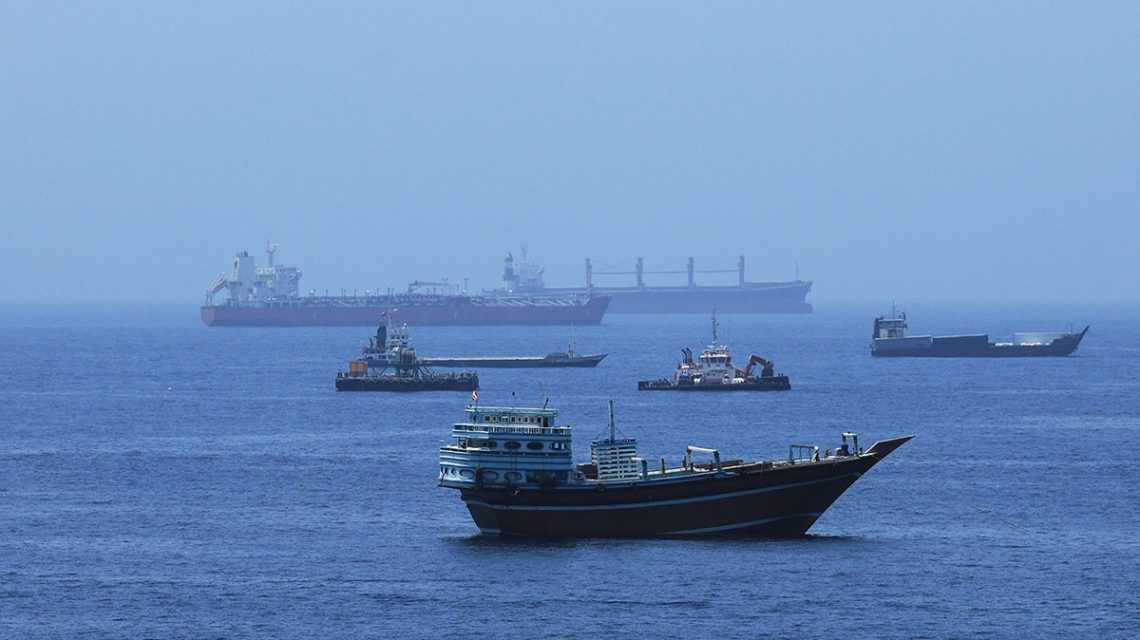
Commercial cargo ships and oil tankers anchor in the Gulf of Oman near Muscat, Oman, preparing to pass through the Strait of Hormuz. This strategic passage continues to be a focal point due to the ongoing conflict. Hanja Maria Richter of Hapag-Lloyd emphasizes the necessity of vigilance and continuous risk assessments to operate safely in the region.
“It is a region in conflict, so we consider this with every single ship we move in the region and assess the risks for every vessel and its crew individually,” Richter stated.
Escalation and Response
The situation intensified as the U.S. Central Command (CENTCOM) conducted airstrikes on Iranian targets, including Qeshm Island, following an attack on a vessel. In return, the IRGC targeted U.S. military sites in Kuwait and Bahrain. This tit-for-tat has led to increased risk within the transit lanes of the region.
Lloyd’s List reports a bifurcation of the waterway into an Iran-controlled northern route and a U.S.-protected southern route, complicating navigation further. Iran’s Foreign Minister Abbas Araghchi affirmed the country’s responsibility for managing traffic through the strait under recent agreements.
Tensions Over Control
Discussions also revolve around controlling the passage through the Strait of Hormuz. Iranian state media stresses coordination with the IRGC for transit. Meanwhile, Hapag-Lloyd opposes fees for passage through this international chokepoint, distinguishing such fees from those applicable to canals with significant infrastructure investments.
“It would be fundamentally wrong to impose fees for passage through international waters,” Richter emphasized.
Despite the difficulties, Hapag-Lloyd successfully navigated the initial closure, ensuring crew safety was a priority.
“Good news is that we were able to have all Hapag-Lloyd vessels that were affected by the temporary closure of the Strait of Hormuz and had been waiting in the Persian Gulf depart safely from the Gulf,” Richter highlighted.
Emma Bussey is a breaking news writer for Fox News Digital. Her previous work experience includes The Telegraph, covering a wide range of topics from foreign affairs to culture.
 Merz Stays Resolute Amid Electoral Shifts in Germany
  U.S.-Iran Relations and Diplomacy at Upcoming U.N. Assembly
  US-China Relations Under Scrutiny: Expert Warns of Escalating Tensions
  Extradition of Suspects in Haitian President’s Assassination
  No Timeline for End of Iran Conflict
  Trump’s UN Visit: Focus on Iran and Reforming the Global Institution