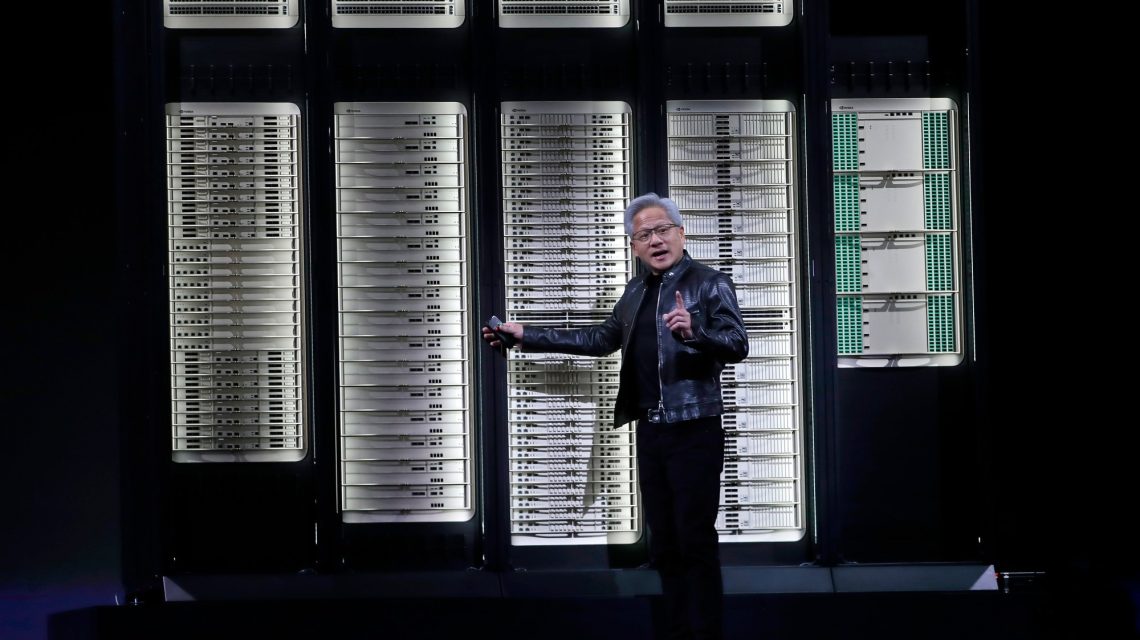
Nvidia has revealed its latest chips designed to enhance artificial intelligence capabilities in personal computers. This announcement was made during the Computex 2026 exhibition in Taipei, Taiwan. New models featuring these advanced chips are expected from well-known brands like Microsoft and Dell later this year.
Currently headquartered in Santa Clara, California, Nvidia is already a leading player in providing high-performance chips for data centers, fueled by the surge in global AI demands. Now, the company seeks to broaden its reach within AI technologies and products. Nvidia’s CEO, Jensen Huang, made this announcement during the annual Nvidia GTC event in Taipei. He emphasized that these developments aim to transform the personal computing landscape, stating, “This is going to be the new PC.”
The focus of this update is the Nvidia RTX Spark superchip, a combination of CPU and GPU, which will power upcoming Windows laptops and desktops. Branded as “AI personal computers,” these devices are expected to be available by the fall. As of now, Nvidia stands as the world’s most valuable company, surpassing giants like Apple, Alphabet, and Microsoft. This innovation positions Nvidia’s superchips to compete strongly against competitors like Intel and AMD.
Following this news, Nvidia shares saw a nearly 4% rise in early U.S. trading, while Intel and AMD experienced a decline of more than 3%. The company aims to reinvent personal computing for both creative and gaming purposes. Huang described a future where AI agents within these computers can interact with users in a more personal way, assisting with tasks like document reading and research. Microsoft shared that computers running on these superchips will handle sophisticated AI models and complex tasks effectively.
Industry analysts see this development as significant, particularly given the rising interest in personal AI agents. Lian Jye Su, chief analyst at Omdia, commented on the increased consumer options this presents, noting, “For consumers, it means more choices, which is always a good thing.” Neil Shah from Counterpoint Research considered this an innovative shift for the PC landscape over the next decade, suggesting that these new devices could establish a standard for home-based “AI supercomputers.”
Additionally, Nvidia announced that its Vera CPUs for data centers are now fully operational and are expected to drive significant growth, with partners including Anthropic, OpenAI, and SpaceXAI. Huang also introduced a prototype of a humanoid robot, designed in collaboration with Chinese robot manufacturer Unitree and Singapore-based Sharpa. This Isaac GR00T robot stands nearly six feet tall and features dexterous hands capable of delicate movements, with potential applications in academic research.
 The Challenges of Regulating AI Unveiled
  Challenges of the Digital Markets Act in the EU
  Scientists Discover Enormous Crater on Moon
  AI Chatbot Concerns: Families and Legislation
  NPR Launches AI-Focused Podcast ‘Machine Gods’
  Trump Proposes ‘AI Force’ to Oversee Artificial Intelligence